Conflicts disclosed
We check for conflicts and disclose relevant involvement before accepting instructions.
MundX turns Form EC8As into court-ready evidence for election petitions. Through detailed analysis and document forensics, we reconcile the figures, examine the sheets for alterations and inconsistencies, and show exactly which polling units are in issue and whether they change the result. Every finding traces back to its source. You get an evidence schedule, technical briefing and, where needed, a witness statement on oath, within 48 hours to 7 days. We act for petitioners and respondents, and all work is strictly confidential under NDA.
Inspect real polling-unit findings ↗We check for conflicts and disclose relevant involvement before accepting instructions.
We execute an NDA before you share confidential case files or litigation strategy.
Files move securely, with access limited to the agreed team and handling terms set with counsel.
Start with party details and a high-level brief.
Move from a broad concern about the election to named units, specific discrepancies and a clear account of what the figures support.
Examine whether the pleaded units, documents and calculations support the allegation and the numerical conclusion advanced.
“invalid by reason of corrupt practices or non-compliance”
Identify the affected polling units, examine documentary inconsistencies and organise the records and questions counsel needs to prove them.
“not duly elected by majority of lawful votes”
Reconcile polling-unit figures, test disputed adjustments and calculate their effect on candidate totals and the margin.
Excerpts from the two grounds in Section 138(1) of the Electoral Act 2026 ↗. Section 139(1): non-compliance does not invalidate an election conducted substantially in accordance with the Act. Read Section 139(1) ↗
Examine the digital files published on the INEC Result Viewing (IReV) portal to test how the forms were captured, processed and published.
Extract recoverable camera, software, time and time-zone fields from the Form EC8A images embedded in IReV files.
Compare printed polling-unit codes, form serials, portal labels and successive images. Identify mismatches and replacements.
Examine shared backgrounds, framing and device-model profiles alongside file hashes. Distinguish duplicates from distinct captures.
Retain Form EC8A files retrieved from IReV or supplied for comparison, record their identifiers and hashes.
We identify questions that require original-device examination, authenticated logs or official inspection.
Begin the geography, source inventory and record checks before declaration where possible, so the 21-day window is spent on findings, not set-up.
Illustrative. Counsel should confirm the applicable computation of time for the specific matter.
Section 285(5) of the Constitution sets the petition filing period. Counsel should confirm the applicable computation for the matter.
Judgment discussing section 285(5) ↗Paragraph 4(5) of the 2026 Act’s First Schedule provides for the witness list, written statements on oath and documents to accompany the petition.
First Schedule, paragraph 4(5) ↗Historical investigations and 2023 judgments may refer to the Electoral Act 2022. Current service references use the Electoral Act 2026.
Named polling units, source values and discrepancies mapped to counsel’s issues, with outstanding evidence flagged.
Candidate totals, coverage, missing units and numerical scenarios, with reproducible calculations and assumptions.
Metadata exports, identity and version comparisons, a source index and file hashes, with methodology notes.
A technical conference to examine the findings. Where required, a witness statement on oath from the analyst.
Examples span different elections and illustrate distinct analytical questions. They are not a combined dataset.
The embedded metadata raises two questions:
Why do the files record capture times before voting began?
The images record times between 05:04:19 and 05:34:17 WAT on 15 April 2023—roughly three hours before the scheduled 8:30am start of polling.
Why do they identify an iPhone rather than BVAS?
All 24 images identify Apple iPhone 13 / iOS 16.4.1 in their embedded metadata, rather than a BVAS device.
For counsel: establish whether the device clock was accurate, when the result sheets were completed, and how these iPhone images entered the official result-publication process. Metadata alone does not establish the actual capture time or the full handling history.
Read the forensic investigation ↗ · 24-Form EC8A dataset ↓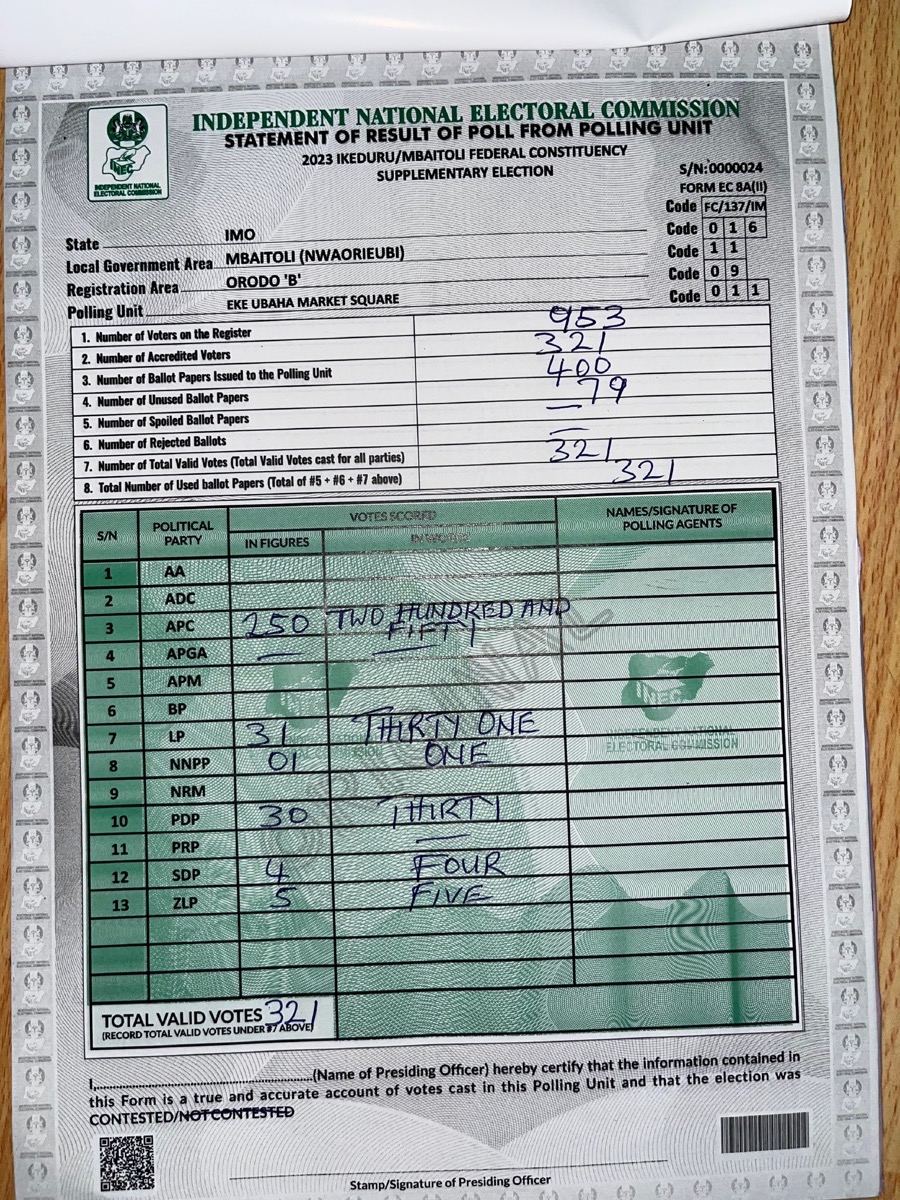
Each mark is one Form EC8A. Device field on every image: Apple iPhone 13 · iOS 16.4.1.
Source: embedded original-time fields in the IReV-published files (24-Form EC8A dataset). Times as recorded by the device; clock settings are part of what counsel should test.
MundX’s count of available Form EC8As covers 4,460 Form EC8As: APC 269,595; PDP 260,833—an 8,762 lead. Declared totals of APC 291,667 and PDP 247,274 give a 44,393 lead. The difference between those margins is 35,631.
4,460 forms
| Party | Form count | Declared | Change |
|---|---|---|---|
| APC | 269,595 | 291,667 | +22,072 |
| PDP | 260,833 | 247,274 | −13,559 |
+22,072 for APC and −13,559 for PDP together make the 35,631.
75 Form EC8As with votes above accreditation as written. A separate question from the margin reconciliation.
For counsel: inspect named Form EC8As, reconcile coverage and corrections, and determine which records explain the return.
Inspect a reviewed Form EC8A ↗Across 1,639 polling-unit results in five contests, the investigation identifies conflicting figures and amended images.
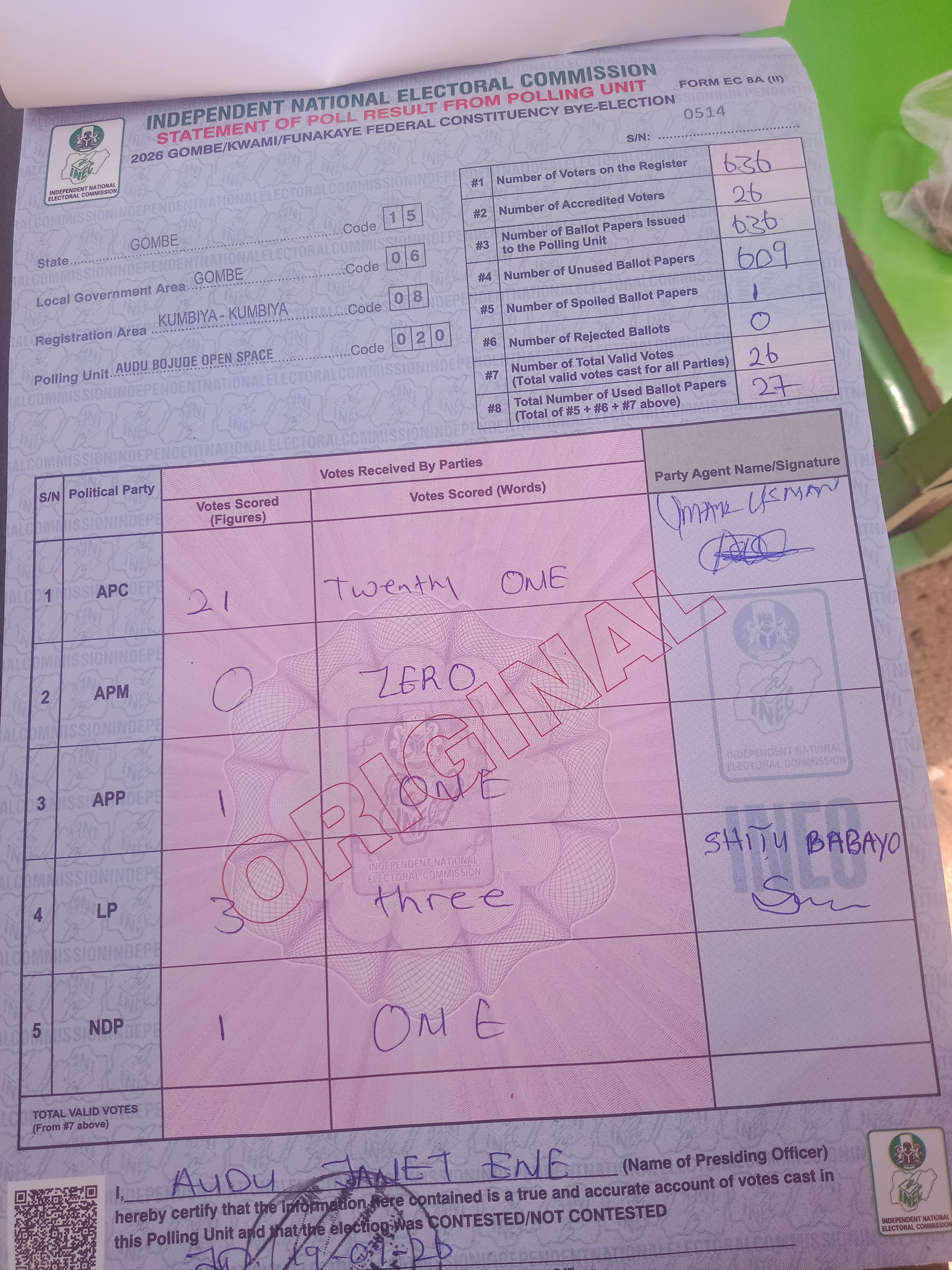
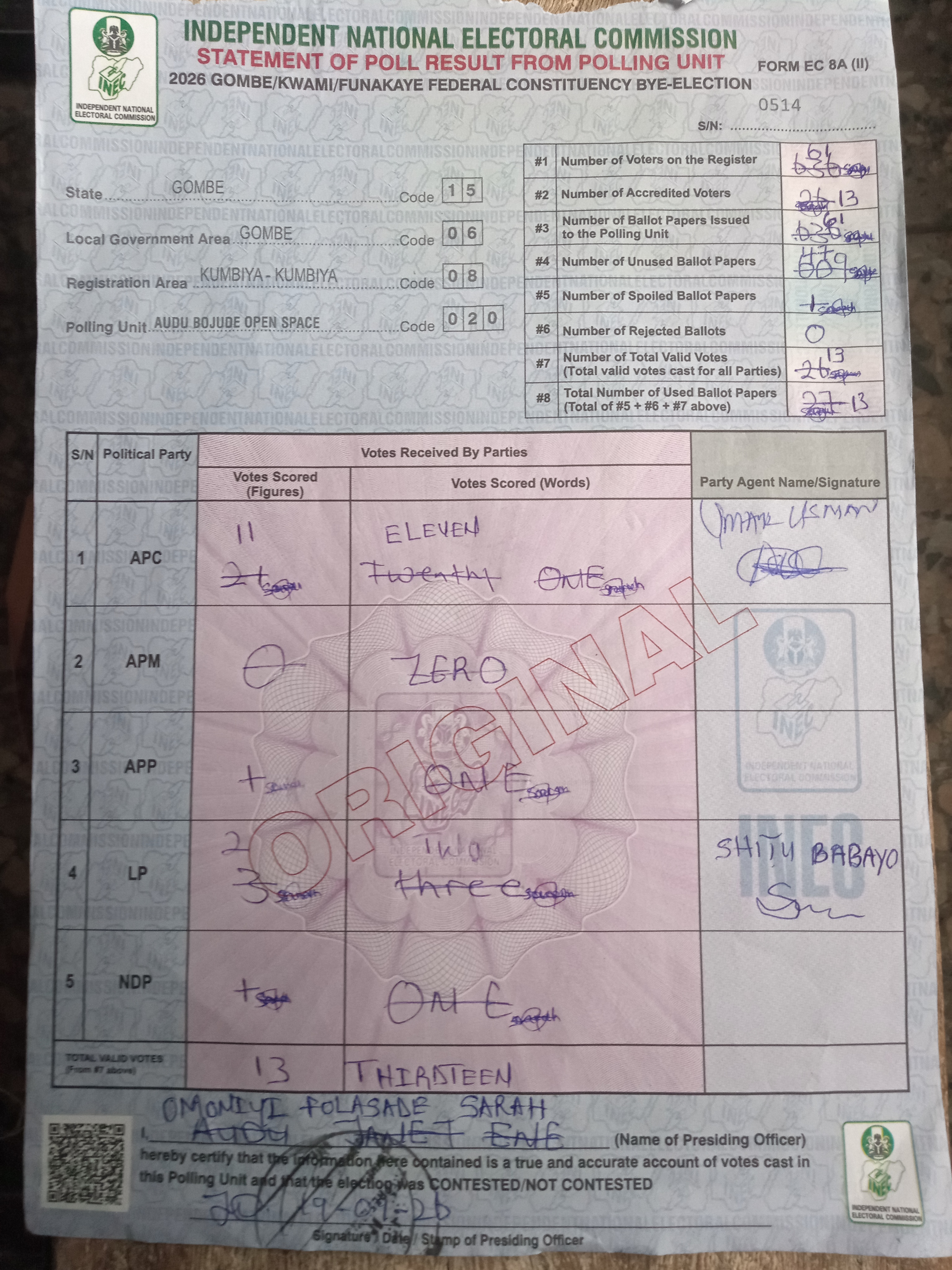
| Printed on the form | Listed 002 | Listed 020 | Result |
|---|---|---|---|
| Polling-unit code | 020 | 020 | Same |
| Form serial | 0514 | 0514 | Same |
| Valid votes | 26 | 13 | Changed |
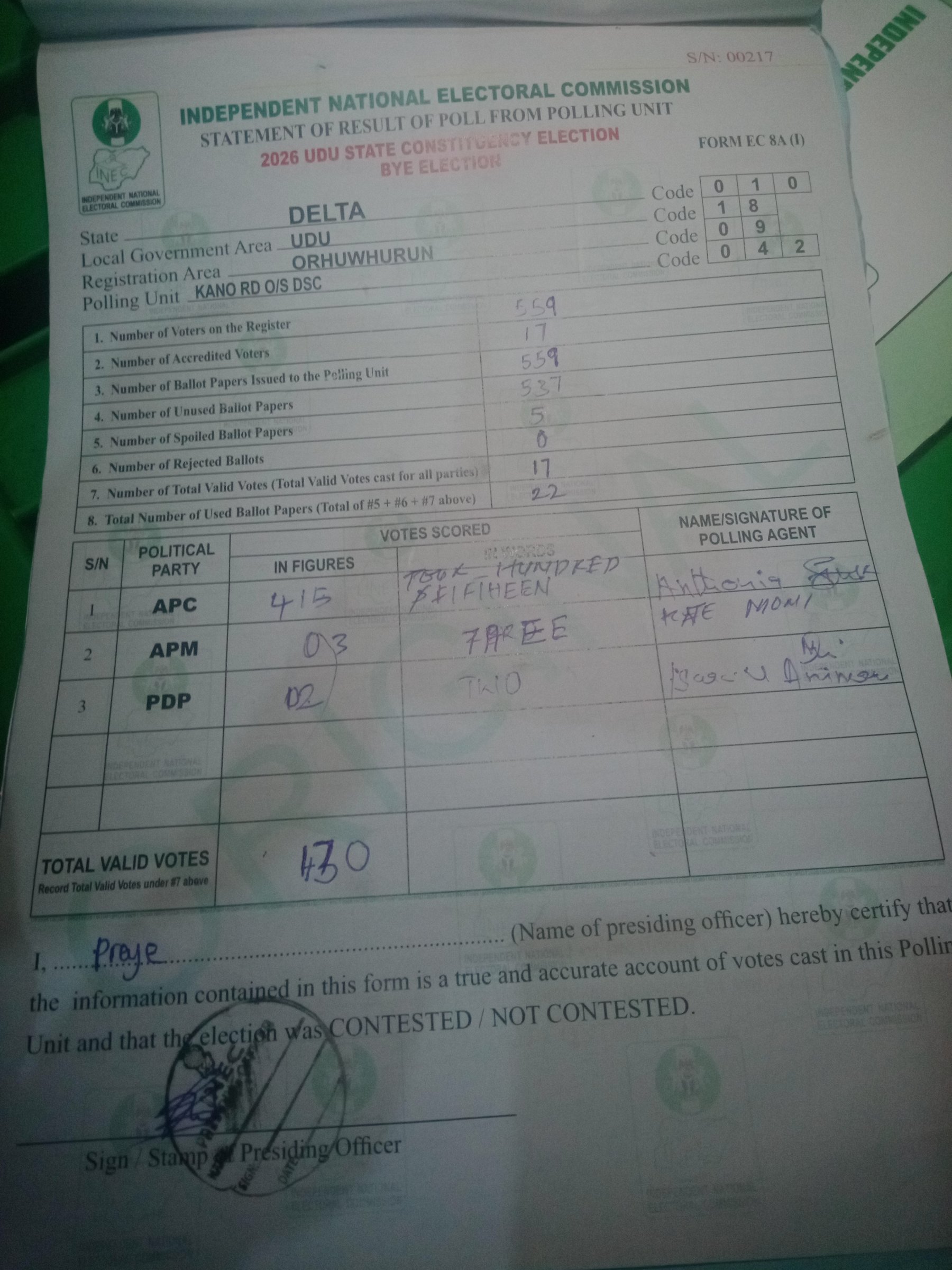
Unit 10/18/09/042 · Kano Rd O/S DSC, Orhuwhurun
Party sum = APC 415 + APM 3 + PDP 2. It is 403 above accreditation and 10 below the bottom total. Establish which figures official collation records substantiate.
Open original Form EC8A ↗Images listed under 15/06/08/002 and 020 both print unit 020 and serial 0514. The stated valid total changes from 26 to 13. Resolve the portal-to-form mismatch and establish the authoritative record.
Unit 10/18/09/042 · Kano Rd O/S DSC, Orhuwhurun. Written accreditation is 17; APC 415, APM 3 and PDP 2 total 420. Valid totals are 17 at the top and 430 at the bottom. The party sum is 403 above accreditation and 10 below the bottom total. Establish which figures official collation records substantiate.
For counsel: identify the document and version under challenge, reconcile the amendments and prepare focused requests for the underlying records.
Full investigation data ↓The available IReV count places LP ahead by 13,043 in Rivers East Senate at 81.36% coverage, and by 30,778 in Obio/Akpor House at 96.37% coverage. INEC returned PDP candidates in both contests.
LP +13,043 in available count
LP +30,778 in available count
The hatched share is why sensitivity testing has to precede a different-winner submission.
For counsel: quantify the missing-record problem and test assumptions before advancing a result theory. Prioritise the 653 unusable Senate units for record recovery and sensitivity testing.
653-unit reconstruction dataset ↓ · Ward summaries ↓Across IReV-published result records, the audit found EMP2920/BVAS model metadata in 52,947 records, another identifiable model in 50,452, and no recoverable model in 61,260.
Denominator: 164,659 accessible IReV result records. Shares rounded to one decimal.
For counsel: use a documented population, denominators and a unit-level source path to target technical inquiries.
Read the device-metadata audit ↗ · State summary ↓Methodology: Findings retain their source, calculation and assumptions. Discrepancies, reconstructed totals and metadata patterns require corroboration; they do not alone establish invalid votes, fraud, a unique device or a different lawful winner. Counsel assesses the evidence and applicable law; the court determines admissibility and the merits.
Tell us the side you represent, the declaration or service date, your immediate deadline and the issues in play.
Confirm the question, available records, missing inputs and first deliverable.
Agree the scope, fee, timetable, review rounds and named personnel, including any witness support. Confirm confidentiality and conflict arrangements.
Carry out the agreed analysis, with review checkpoints for counsel.
Review the completed work with counsel and agree any follow-up.
Depending on scope.
We can work with data from any source: IReV Form EC8As, BVAS machine accreditation records, certified true copies and collation records.
Yes, on the timetable agreed at instruction. We coordinate the statement, supporting schedules and exhibits with counsel.
We report that finding. Counsel receives the supporting calculations, the limitations and any unresolved questions.
Meet the analysts behind your evidence ↗
Request a focused assessment of the support your team needs.
[email protected]