24 result sheets. One iPhone profile. Timestamps before polls opened.
Twenty-four photographs of polling-unit result sheets from the Ikeduru/Mbaitoli supplementary election carry the same metadata profile: Apple iPhone 13, running iOS 16.4.1. Their embedded camera times run from 5:04 a.m. to 5:34 a.m. on election day—hours before INEC’s scheduled 8:30 a.m. start of voting.
The 24 images are distinct. They cover six wards, share a strikingly similar wooden background, and record 8,081 valid votes—2.63 times the final announced margin in the constituency.
The finding
The files point to a common photographing setup
The shared model and software do not contain a unique serial number. But taken together with the compressed time sequence and matching visual setting, the available evidence strongly suggests that the sheets were photographed with one device in one common setup.
All 24 embedded photographs identify Apple as the maker, iPhone 13 as the model and iOS 16.4.1 as the software. Their original-time fields carry an explicit +01:00 offset, and their image hashes show that they are not duplicate files.
The metadata does not contain a unique device identifier, and no usable GPS coordinates survive. A misconfigured clock, edited metadata or another undocumented processing history cannot be ruled out.
The visual receipt
Different polling units, the same-looking floor
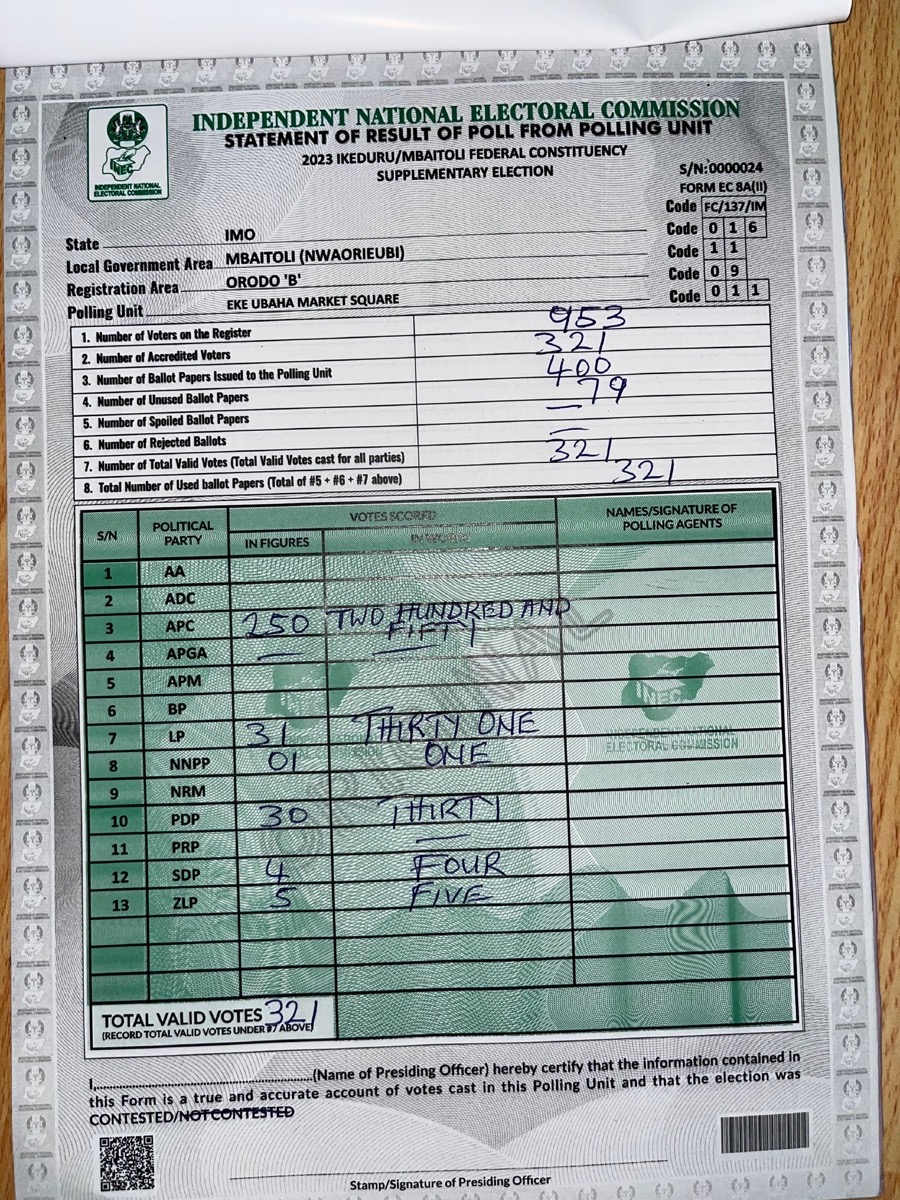
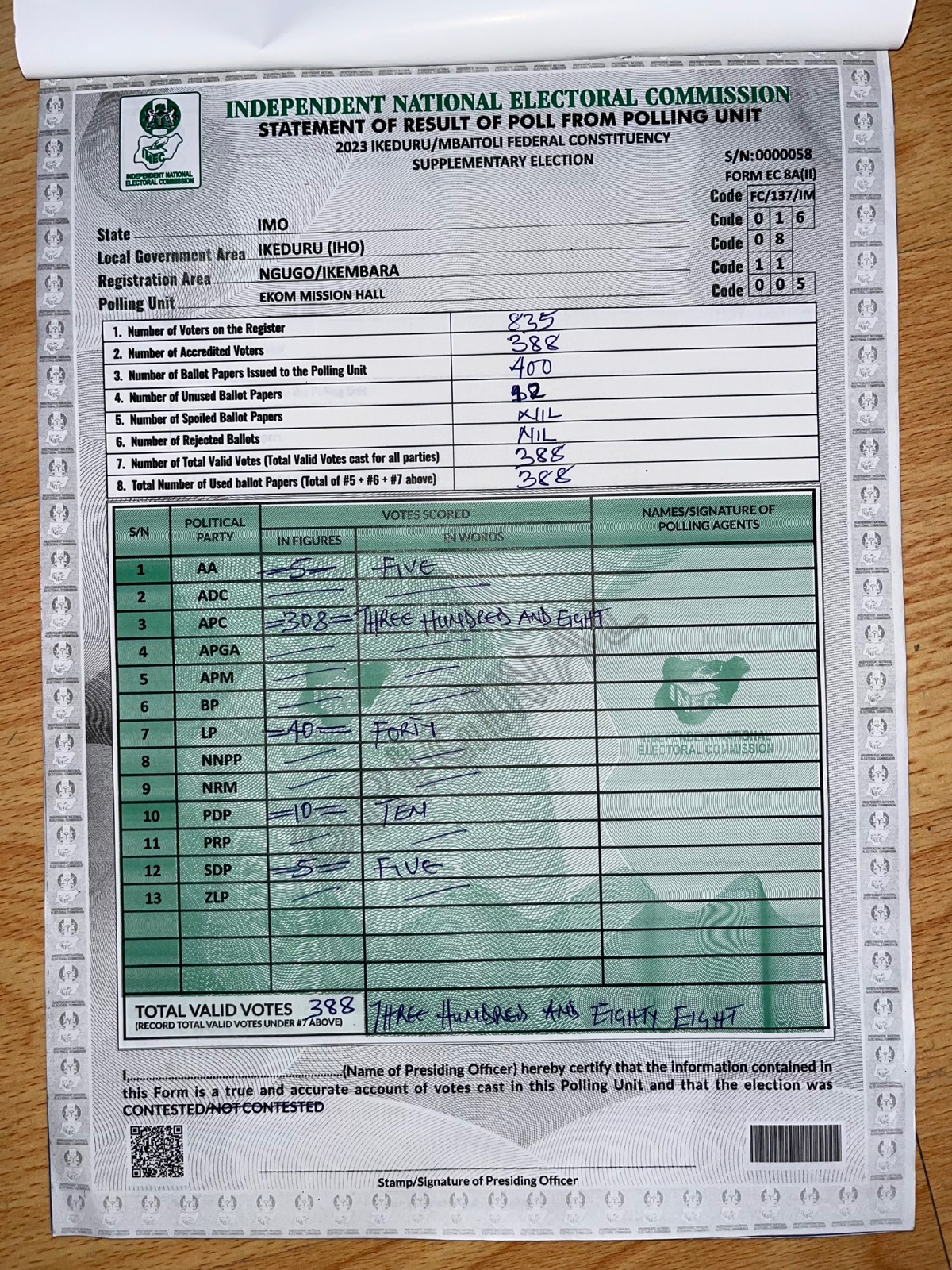
Across the 24 photographs, the forms sit on a similar wood-grain surface. The lighting, shadows, framing and placement of the result sheets also repeat. The polling-unit labels change; the photographic setting appears not to.
The sequence spans Ogbaku, Amaike Mbieri, Afara/Eziama, Orodo ‘B’, Ogwa I and Ngugo/Ikembara wards. Twenty-three of the sheets are labelled for Mbaitoli polling units and one for Ikeduru.
This visual comparison supports a common-setting inference. It cannot identify the building, address or person behind the camera.
The time conflict
The camera times precede the election timetable
INEC’s published 2023 voting procedure says voting starts at 8:30 a.m. The first iPhone-tagged image records 5:04:19 a.m. Twenty-three more run from 5:24:07 a.m. to 5:34:17 a.m.
Twenty-four distinct result-sheet photographs carry these original-time values and an explicit +01:00 offset.
The published election procedure says accreditation and voting commence at 8:30 a.m.
The filename epochs and PDF creation fields for the full 58-sheet cohort fall within this later window. They are processing indicators, not authenticated server logs.
The blank certification fields
The sheets carry totals—but no clearly completed officer certification
Each form contains a certification line for the presiding officer’s name and a separate line for the officer’s stamp or signature. In a sheet-by-sheet visual review, Mundx could not identify a completed presiding-officer name or a clear stamp/signature on any of the 24 images.
The names-and-signatures column for polling agents also appears blank throughout the 24-sheet set. Some vote words and pen strokes extend across the table, but they do not form identifiable agent names or signatures in the designated column.
The blank areas appear beneath the printed certification statement and beside the recorded party figures. INEC should explain whether signed originals exist elsewhere and why the published IReV copies do not show them.
Why the 24 sheets matter
They contain 8,081 valid votes. The final margin was 3,076.
Mundx manually reread the stated total-valid-vote field on every one of the 24 sheets and added the values twice. Together, the forms record 8,081 valid votes.
Contemporaneous reports quote the returning officer as declaring APC candidate Akarachi Amadi the winner with 21,372 votes, ahead of Labour Party candidate Uche Ogbuagu on 18,296. The difference is 3,076 votes.
The 8,081 figure is the total number of valid votes for all parties on these 24 sheets. It is not a candidate margin. The comparison shows scale: this subset of polling-unit records contains more than twice the number of votes that separated the two leading candidates in the final constituency announcement.
Inspect the evidence
All 24 iPhone-profile result sheets
The images below are orientation-corrected web copies of the photographs embedded in the IReV PDFs. Select any image to open it at a larger size. Source-PDF links are included where the current IReV file address remains available.
05:04:19 WAT · 388 valid votesIReV PDF →
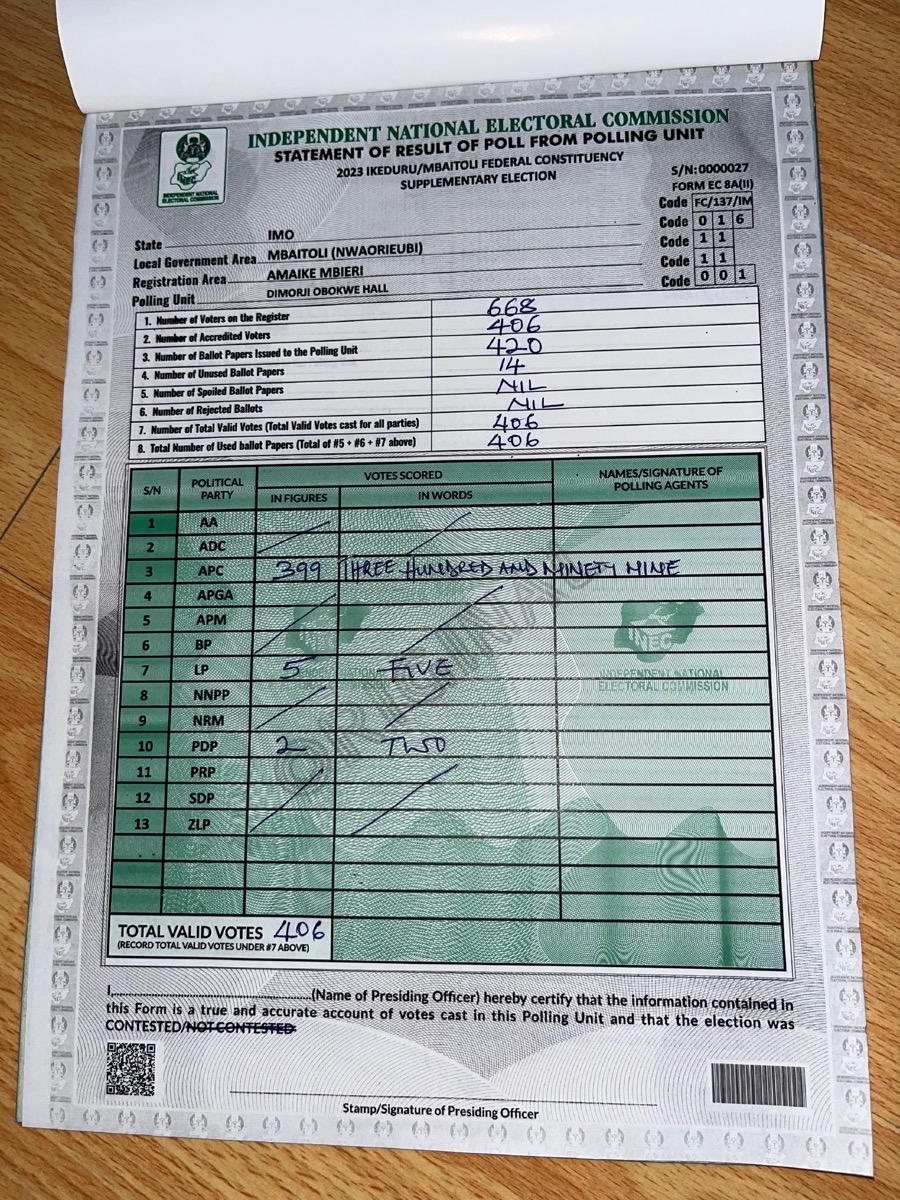
05:24:07 WAT · 406 valid votesIReV PDF →
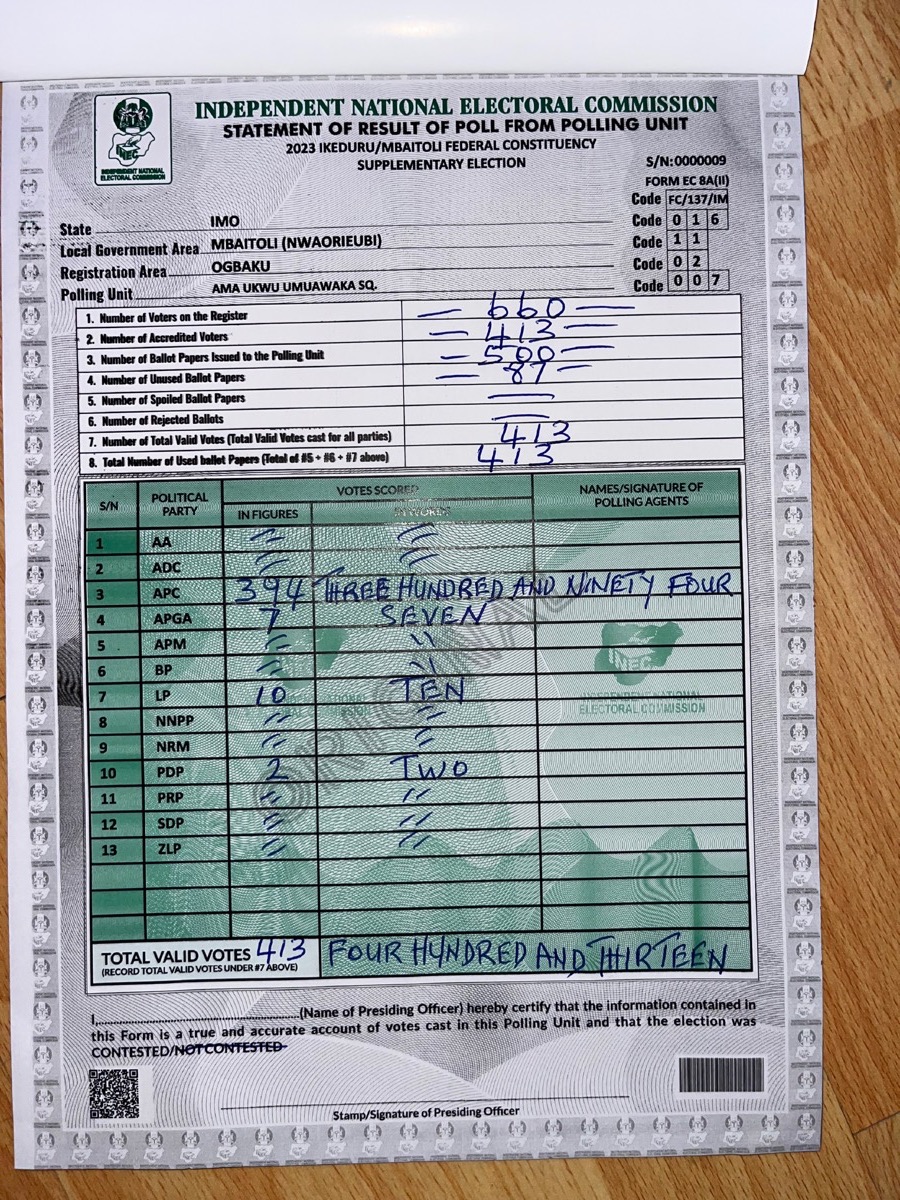
05:25:06 WAT · 413 valid votesIReV PDF →
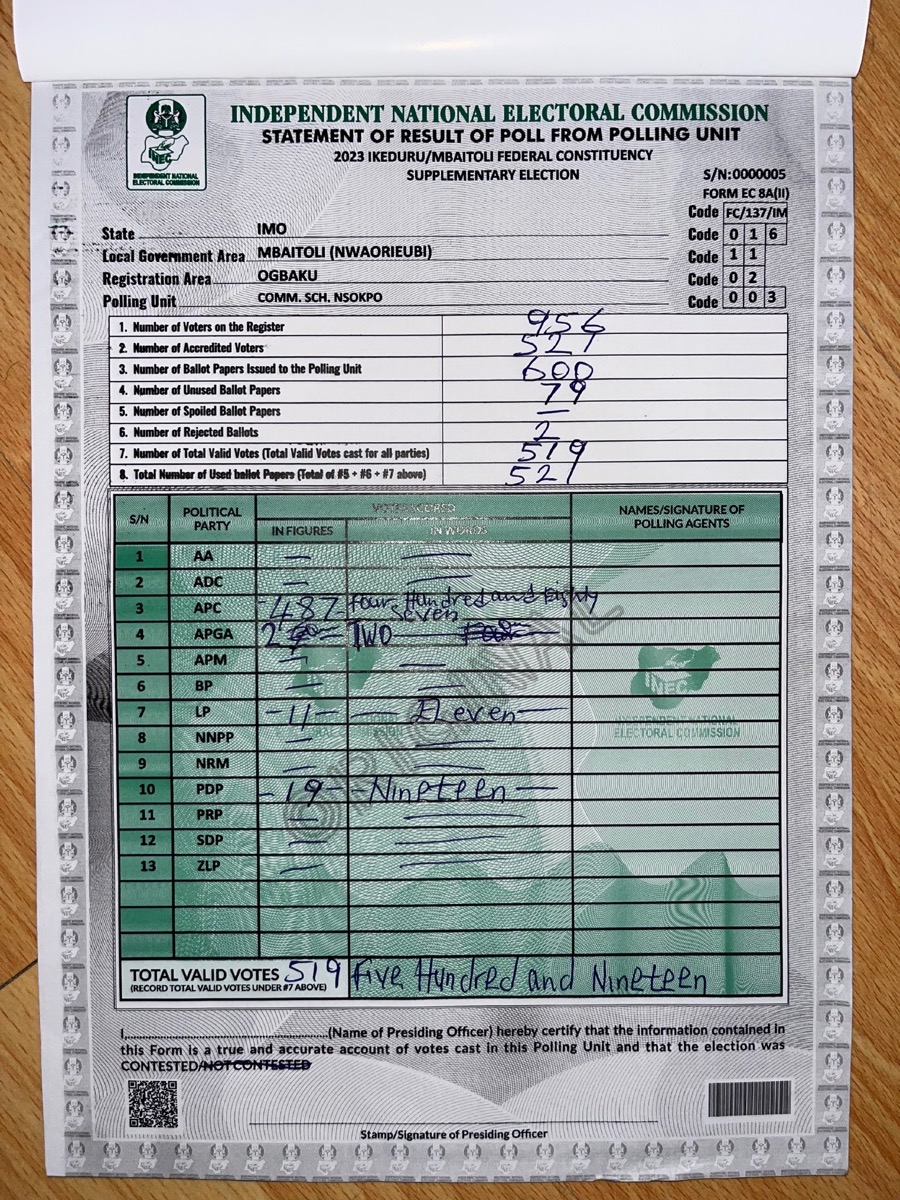
05:25:33 WAT · 519 valid votesIReV PDF →
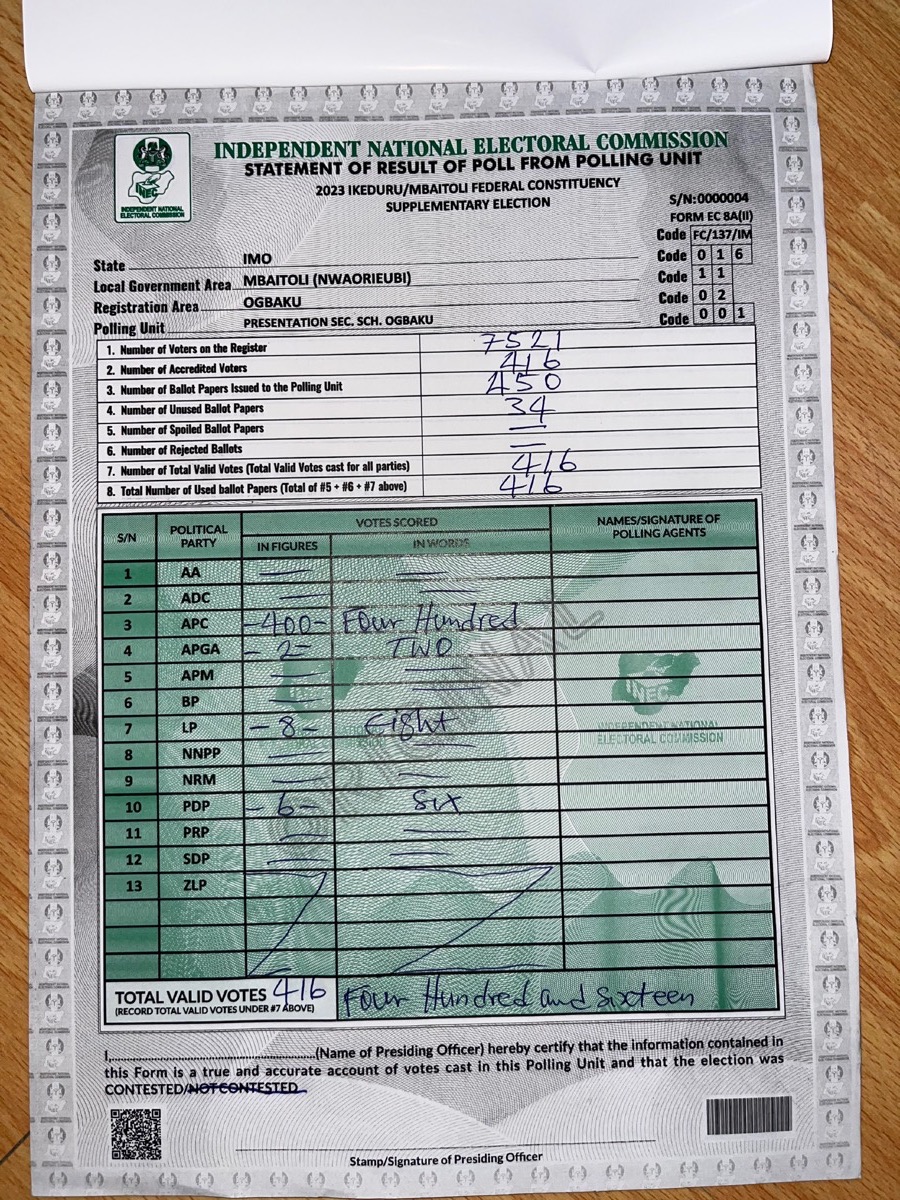
05:25:58 WAT · 416 valid votesIReV PDF →
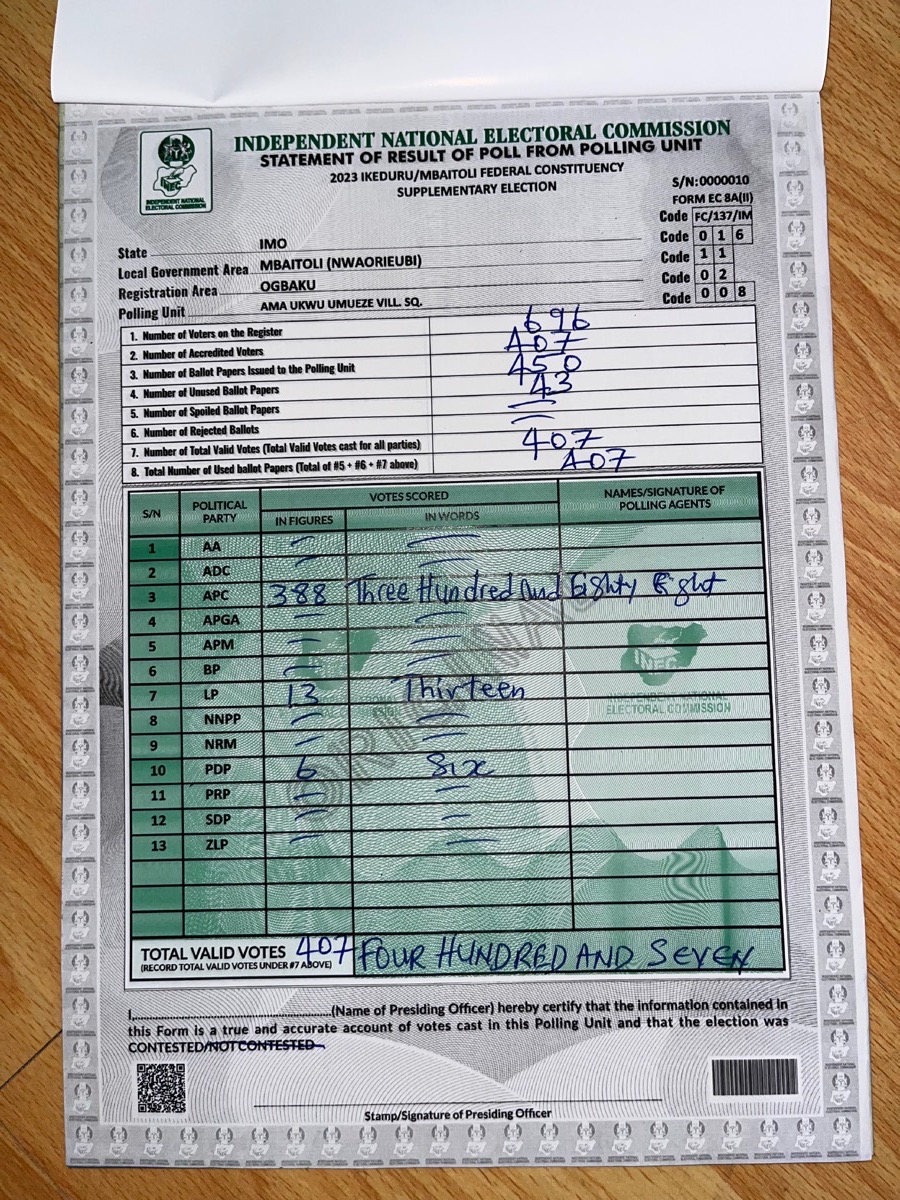
05:26:17 WAT · 407 valid votesIReV PDF →
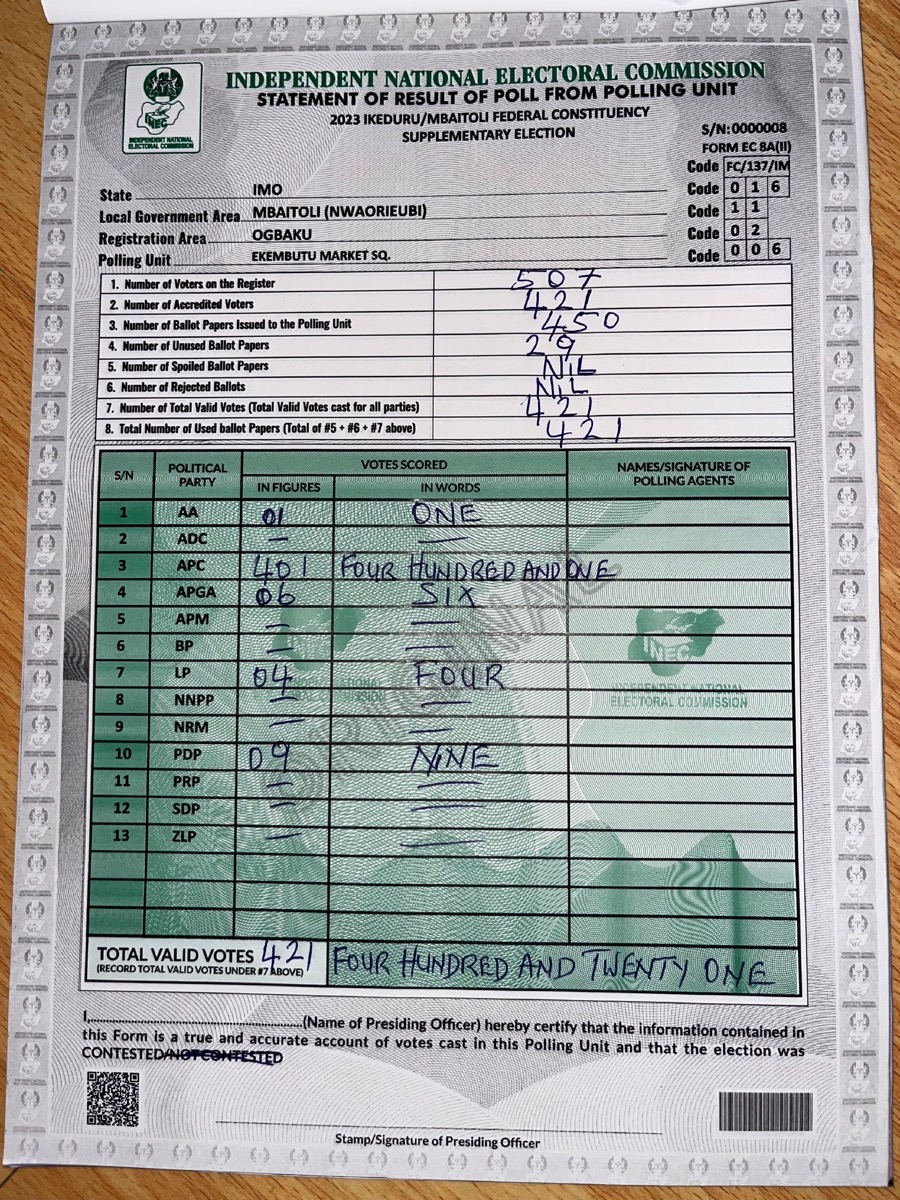
05:26:34 WAT · 421 valid votesIReV PDF →
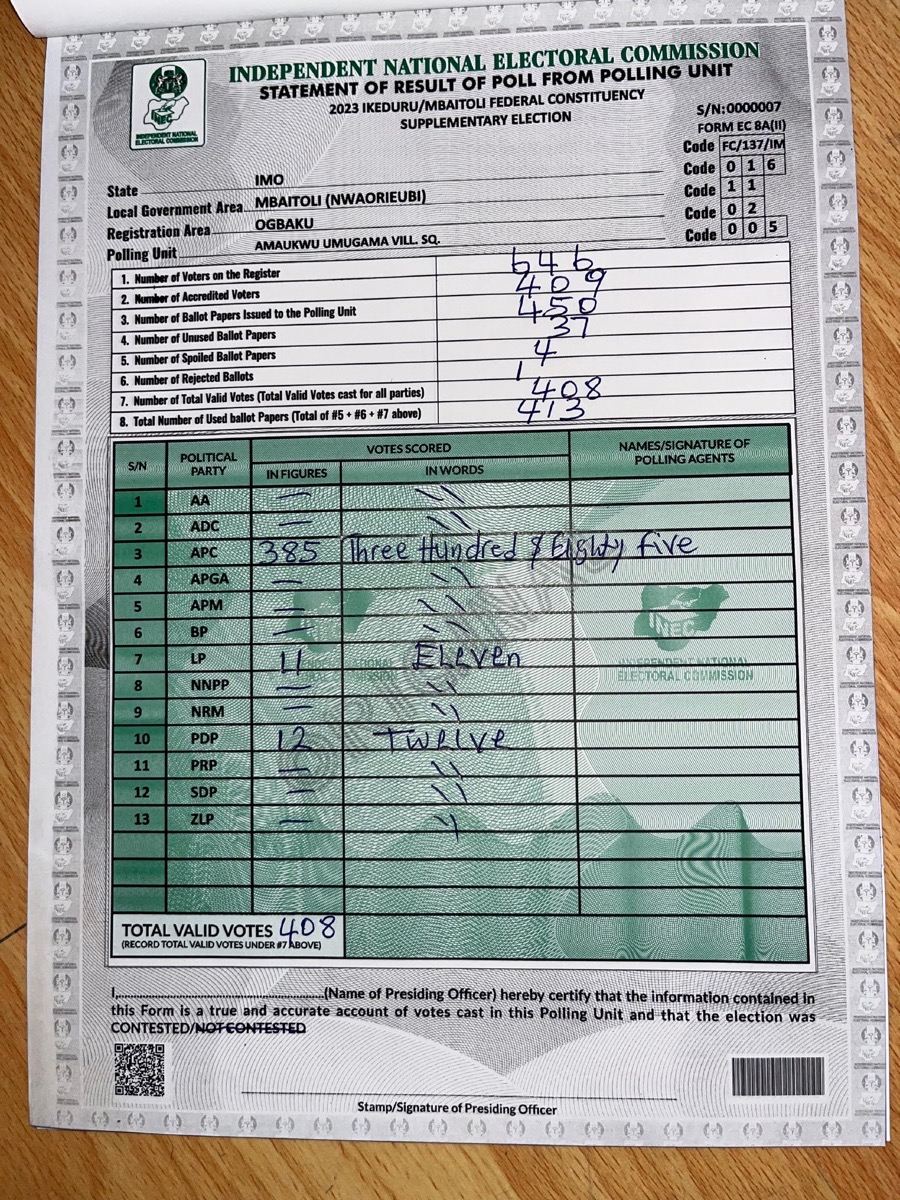
05:27:01 WAT · 408 valid votesIReV PDF →
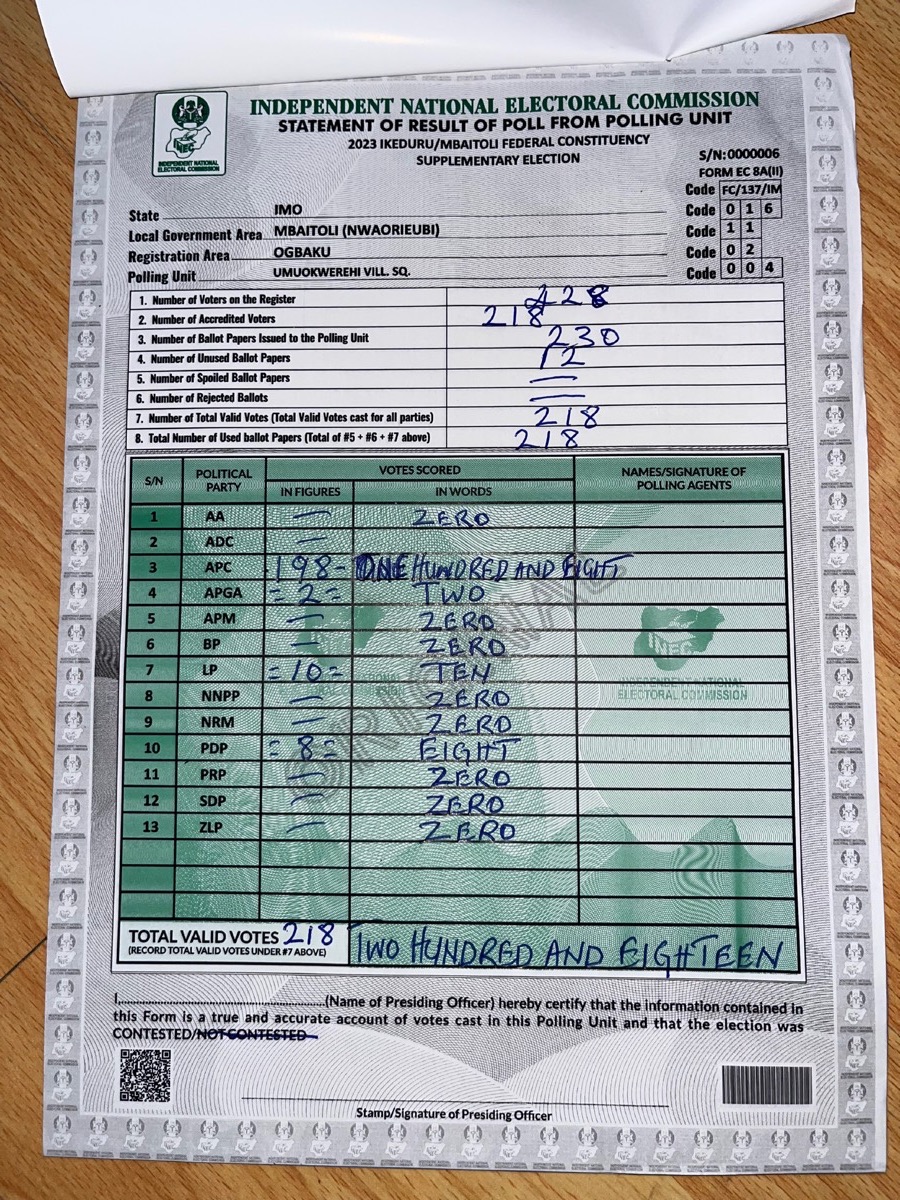
05:27:16 WAT · 218 valid votesIReV PDF →
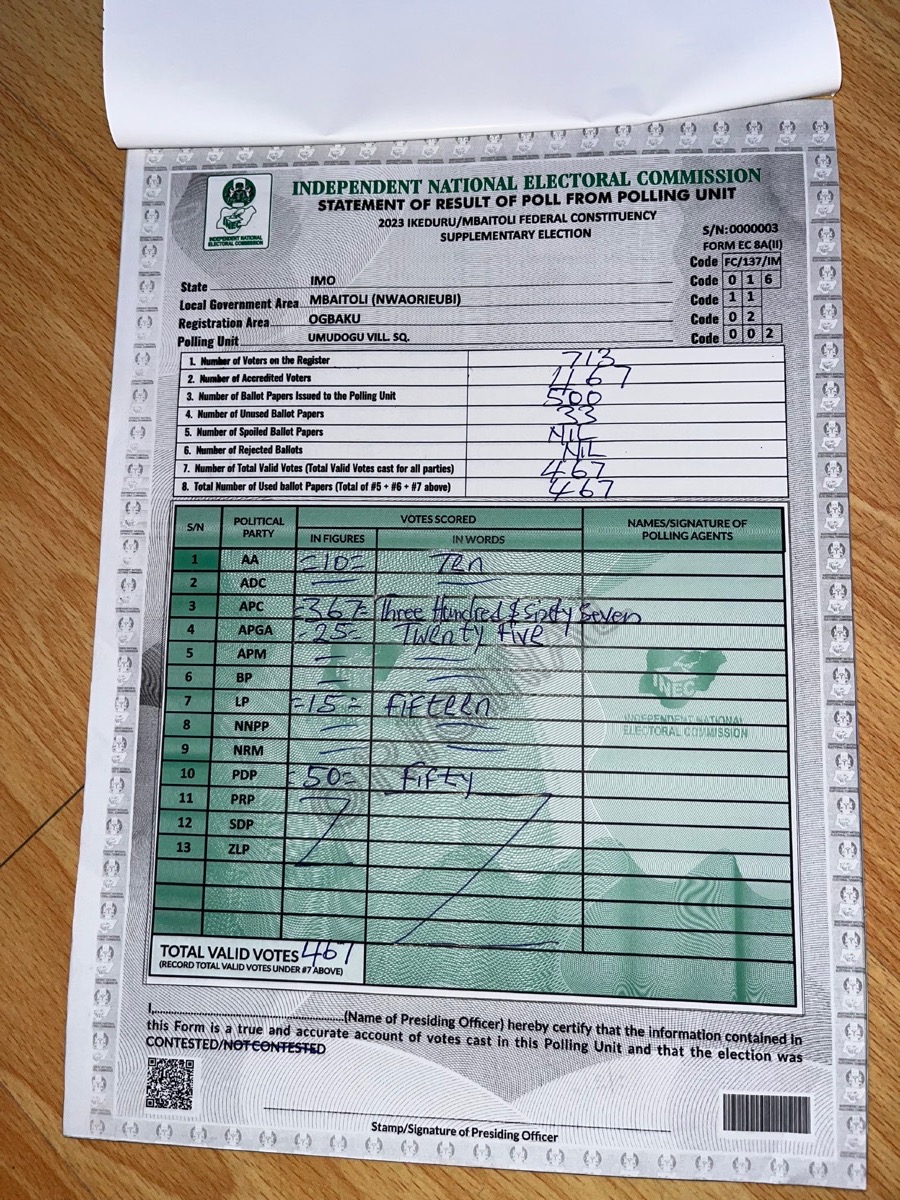
05:27:33 WAT · 467 valid votesCurrent API link uses the unavailable legacy host; preserved image shown.
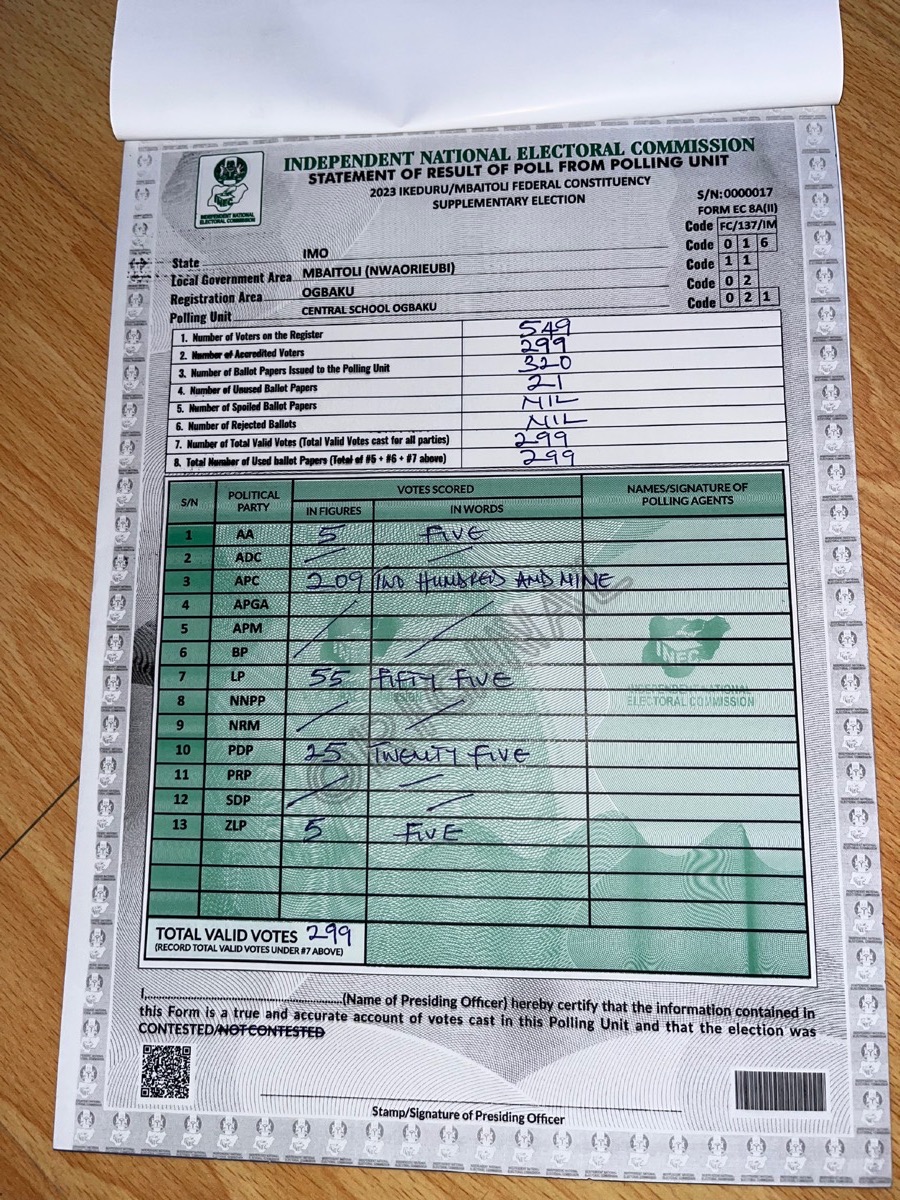
05:28:15 WAT · 299 valid votesIReV PDF →
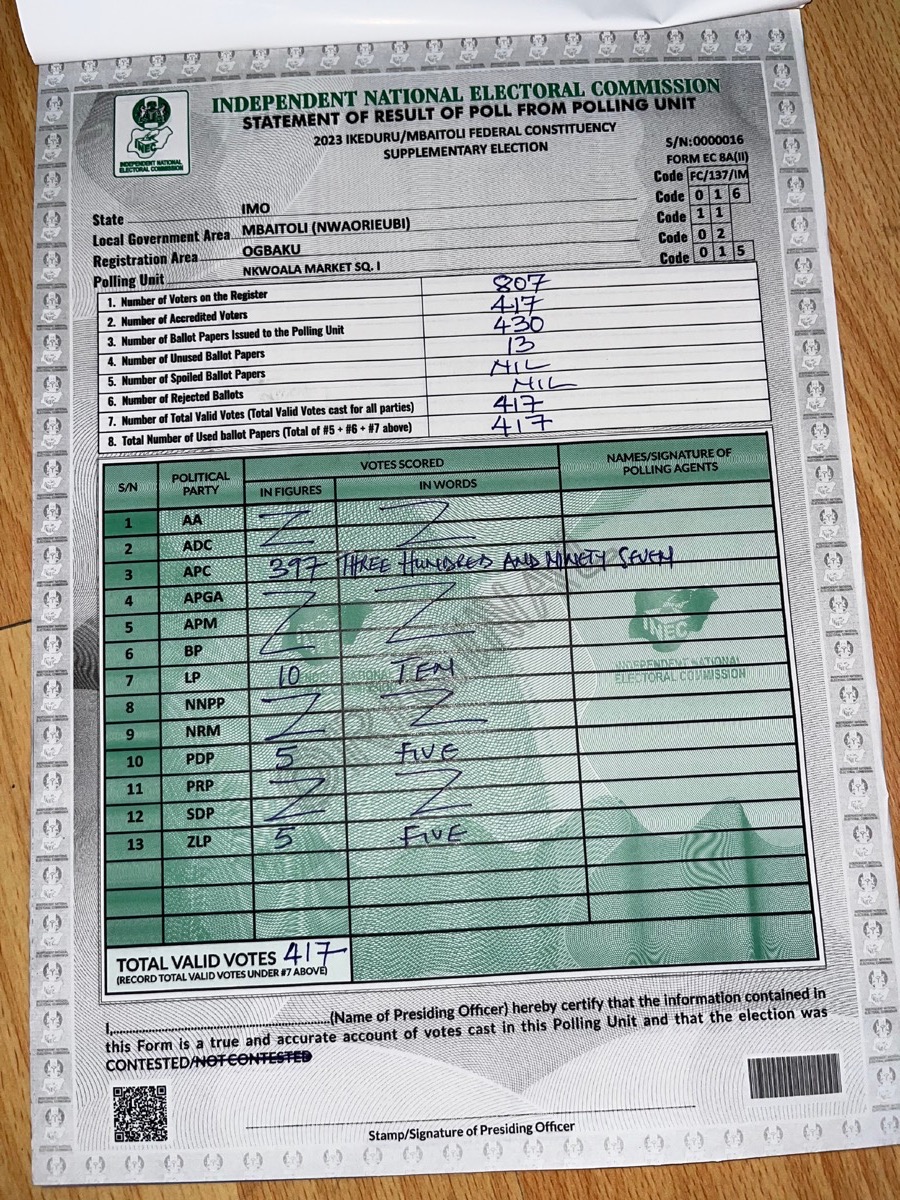
05:28:29 WAT · 417 valid votesIReV PDF →
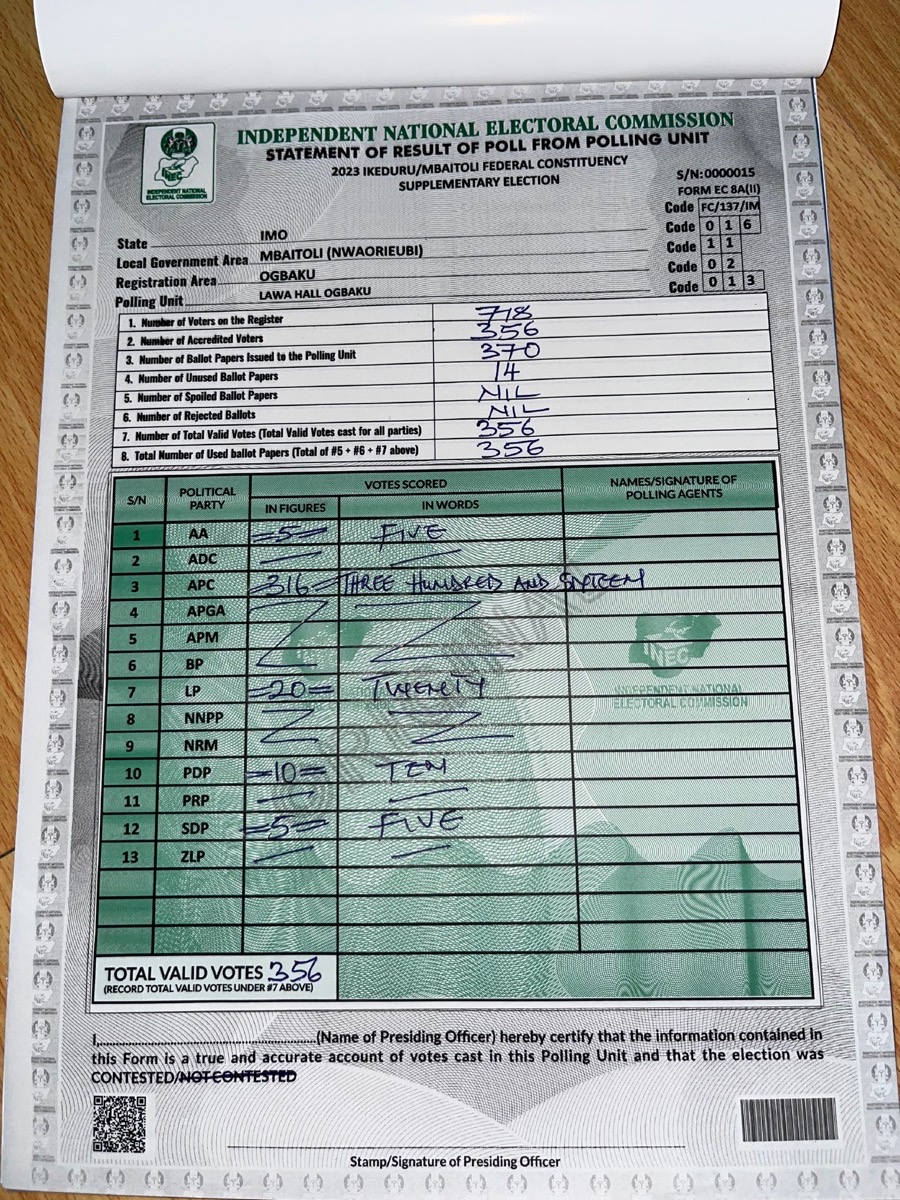
05:28:46 WAT · 356 valid votesIReV PDF →
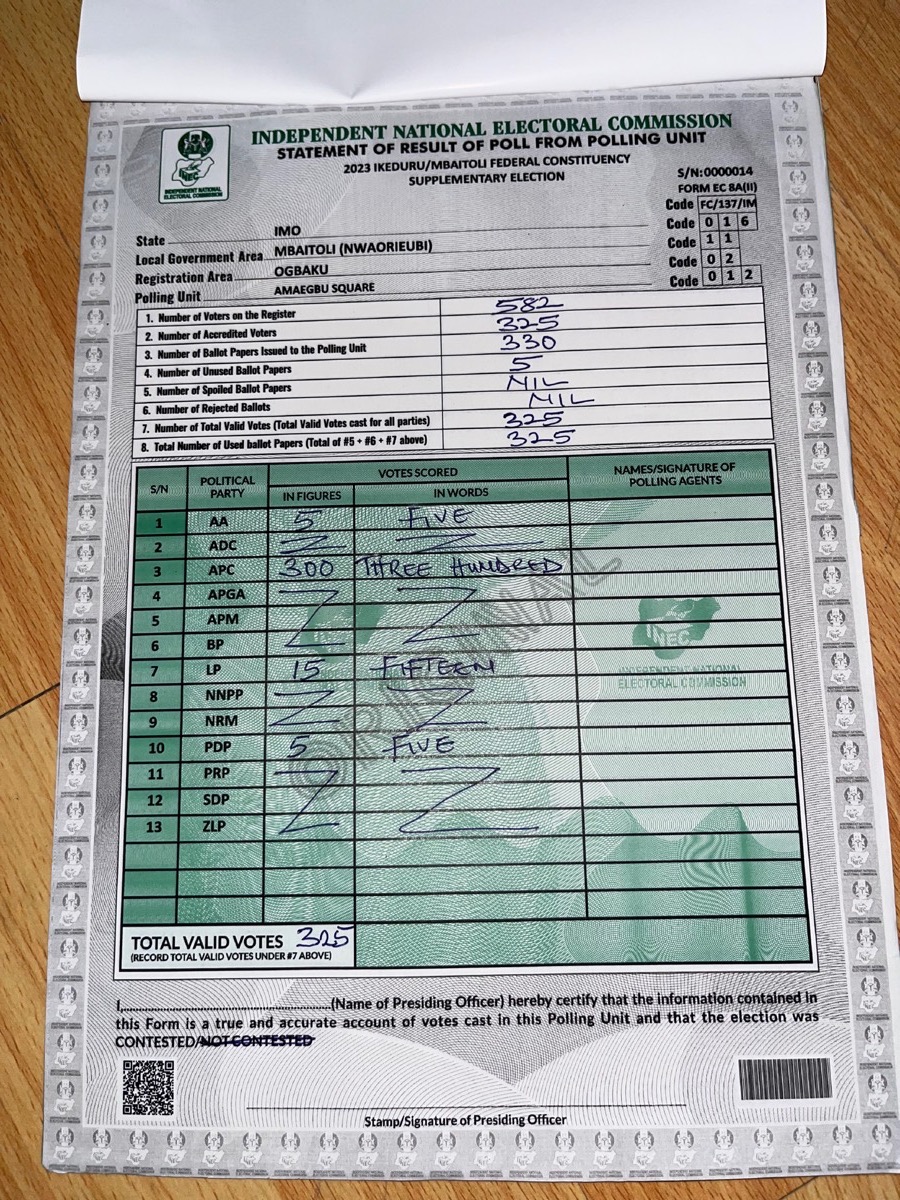
05:29:01 WAT · 325 valid votesIReV PDF →
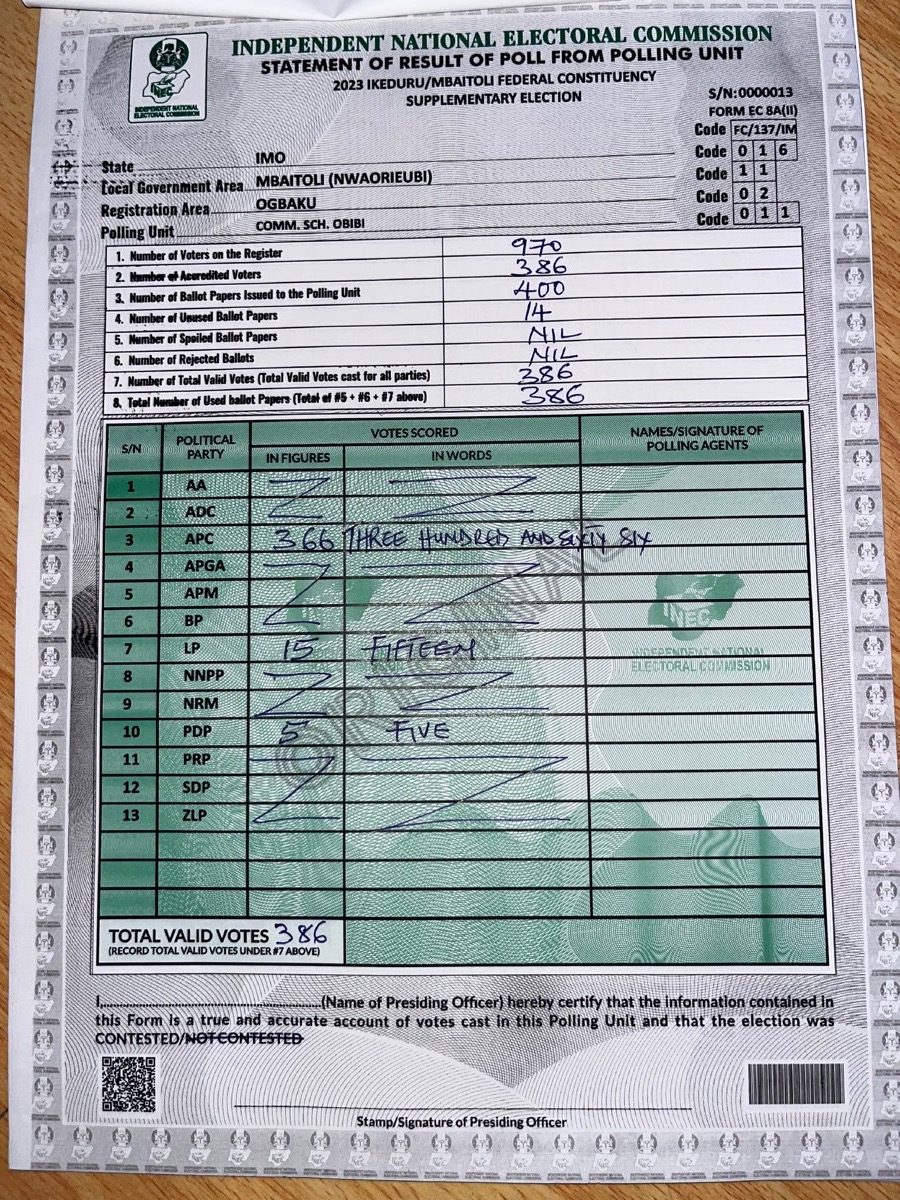
05:29:21 WAT · 386 valid votesIReV PDF →
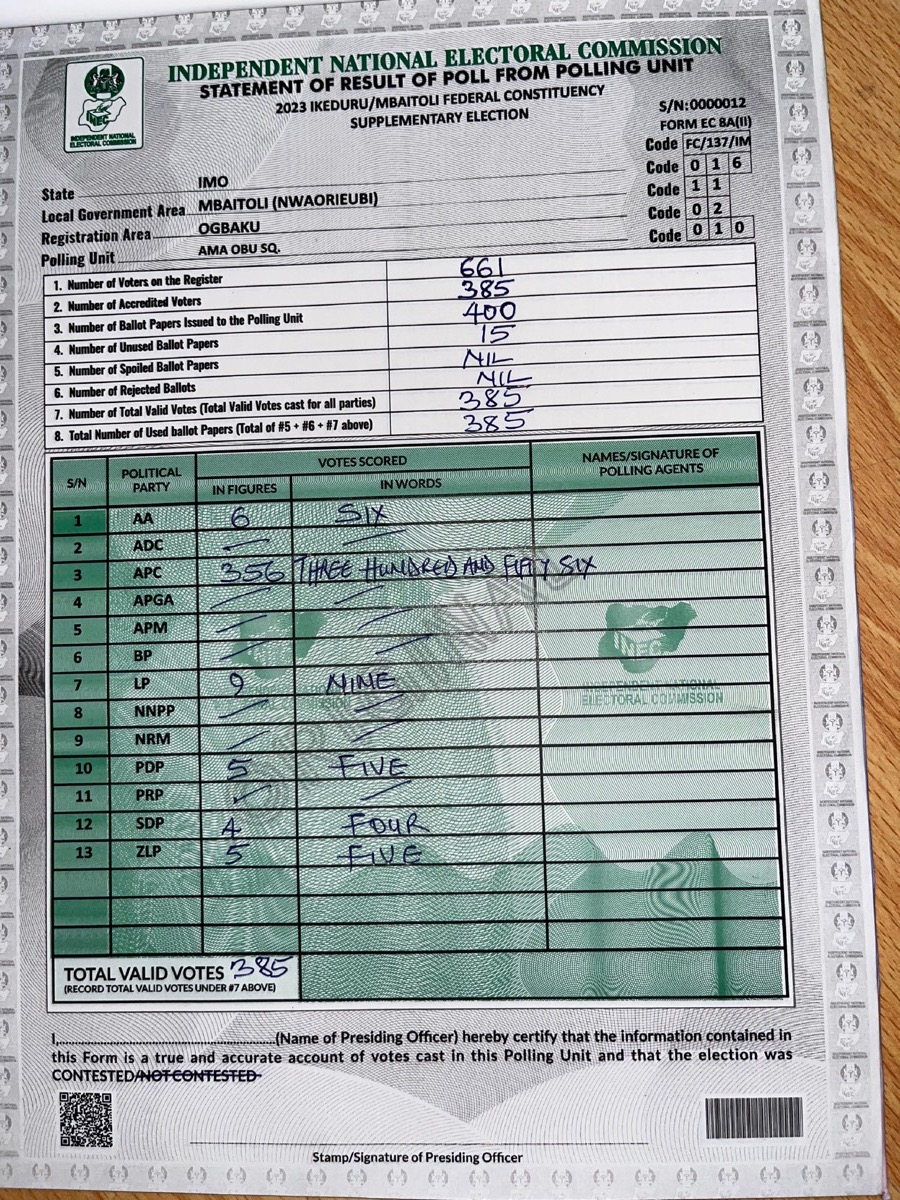
05:29:34 WAT · 385 valid votesIReV PDF →
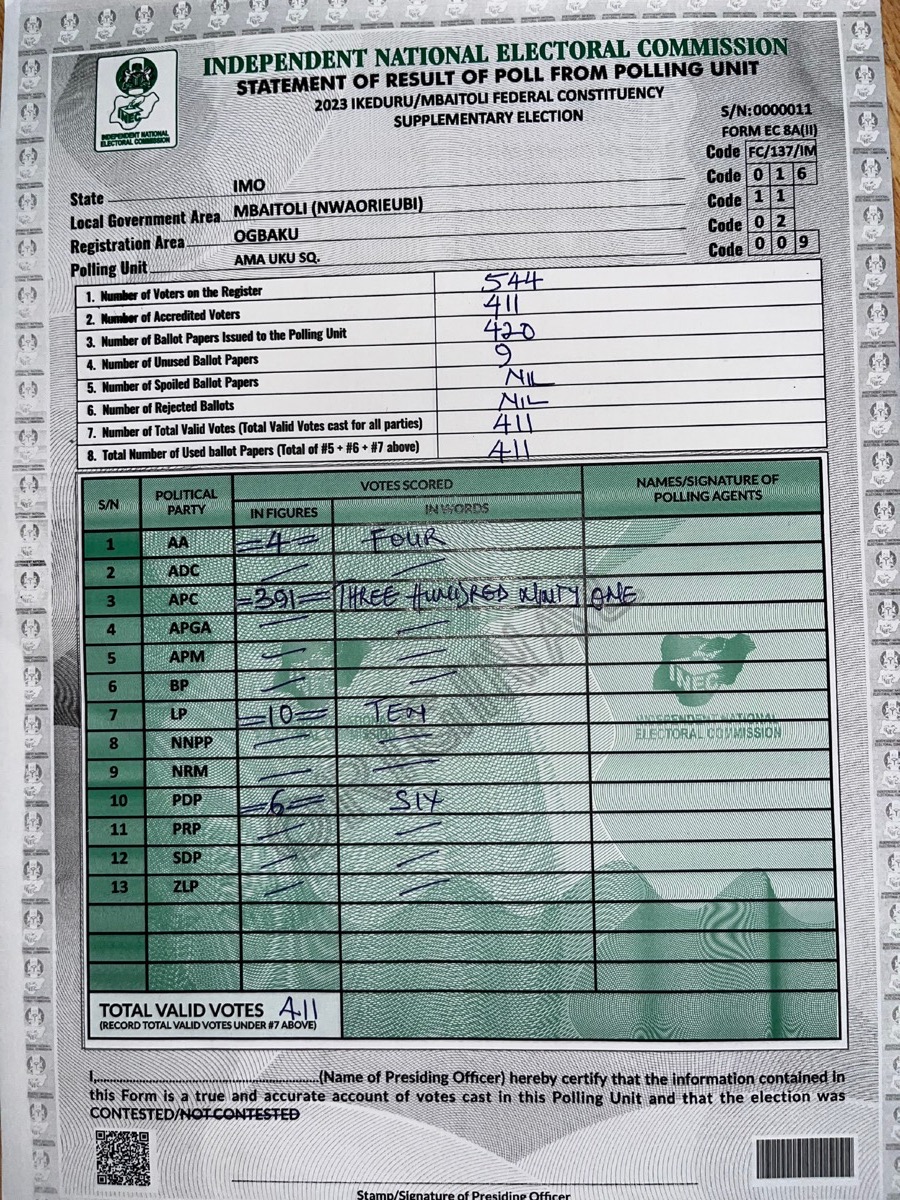
05:29:49 WAT · 411 valid votesIReV PDF →
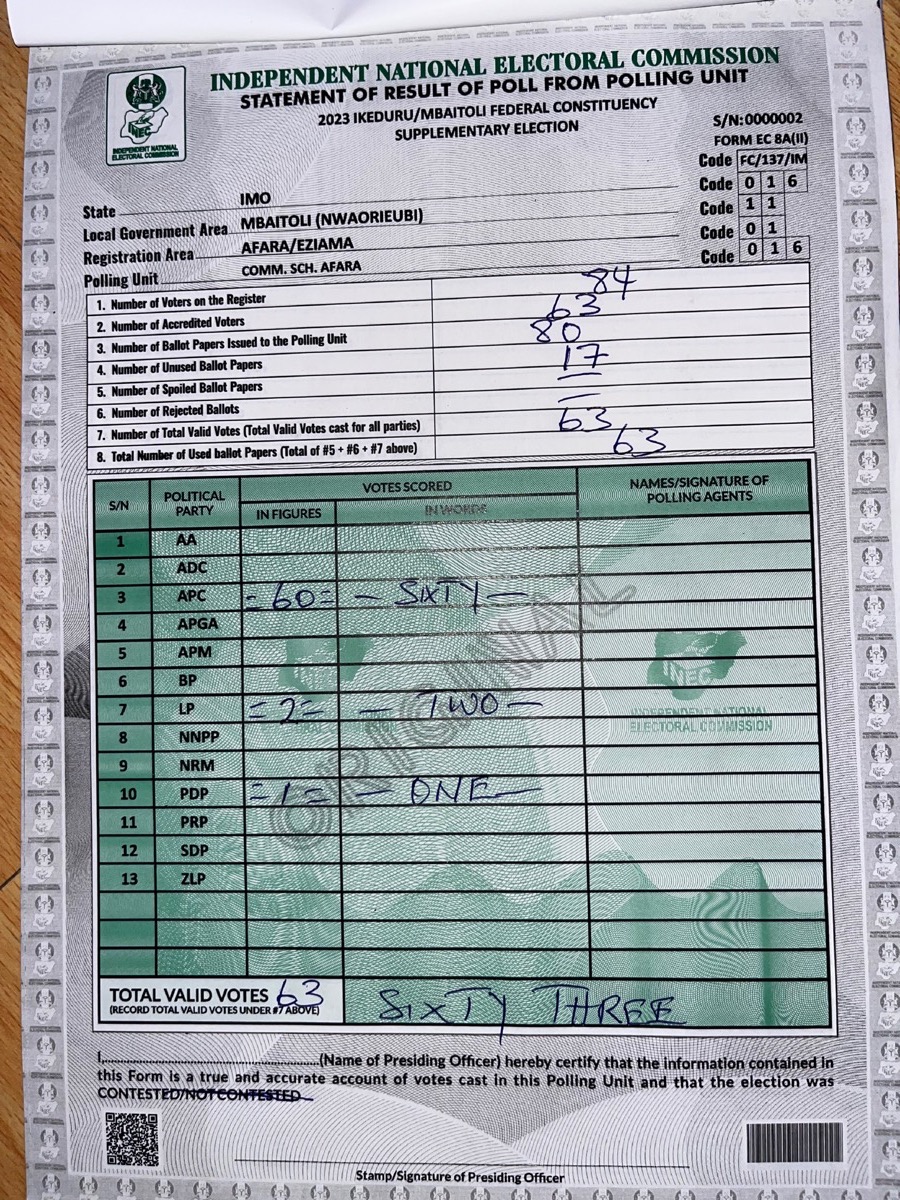
05:30:21 WAT · 63 valid votesIReV PDF →
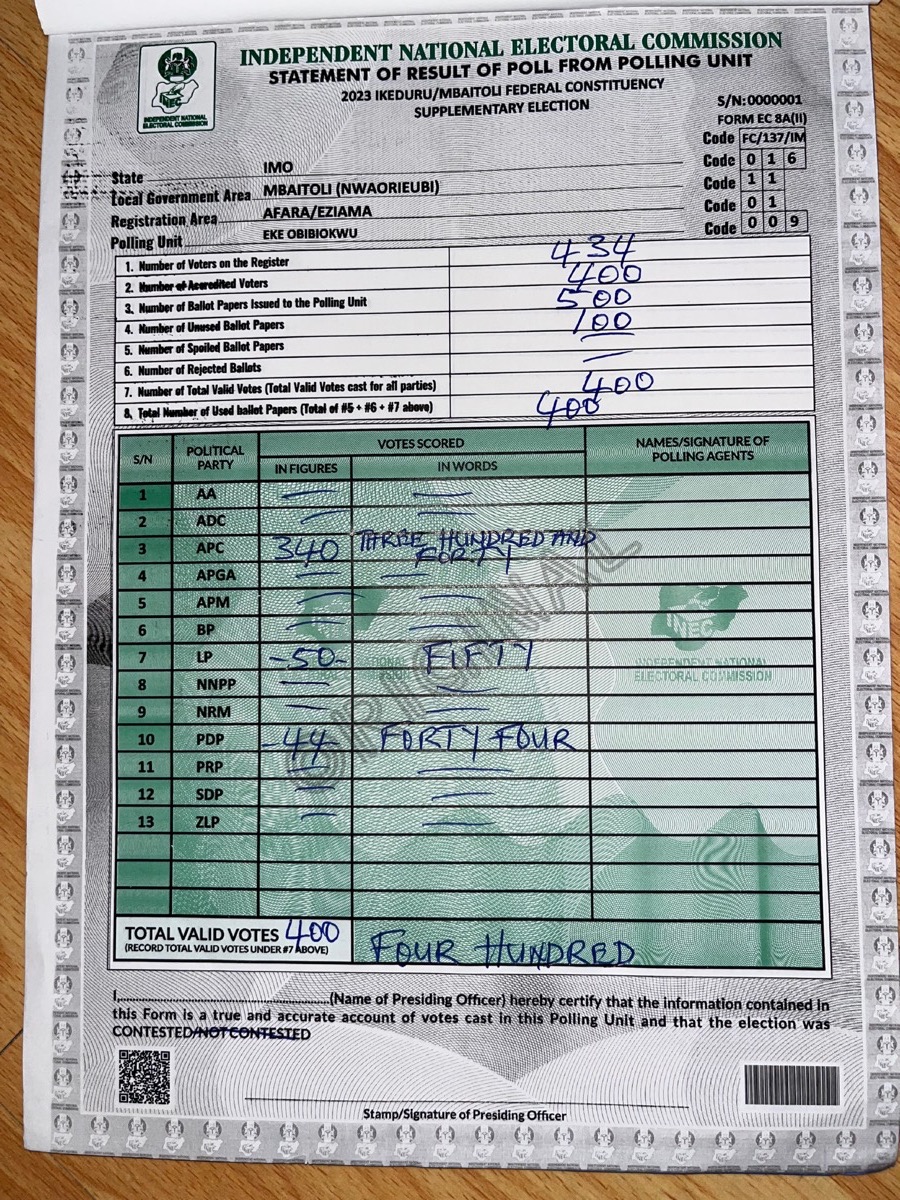
05:30:39 WAT · 400 valid votesIReV PDF →
05:31:20 WAT · 321 valid votesIReV PDF →
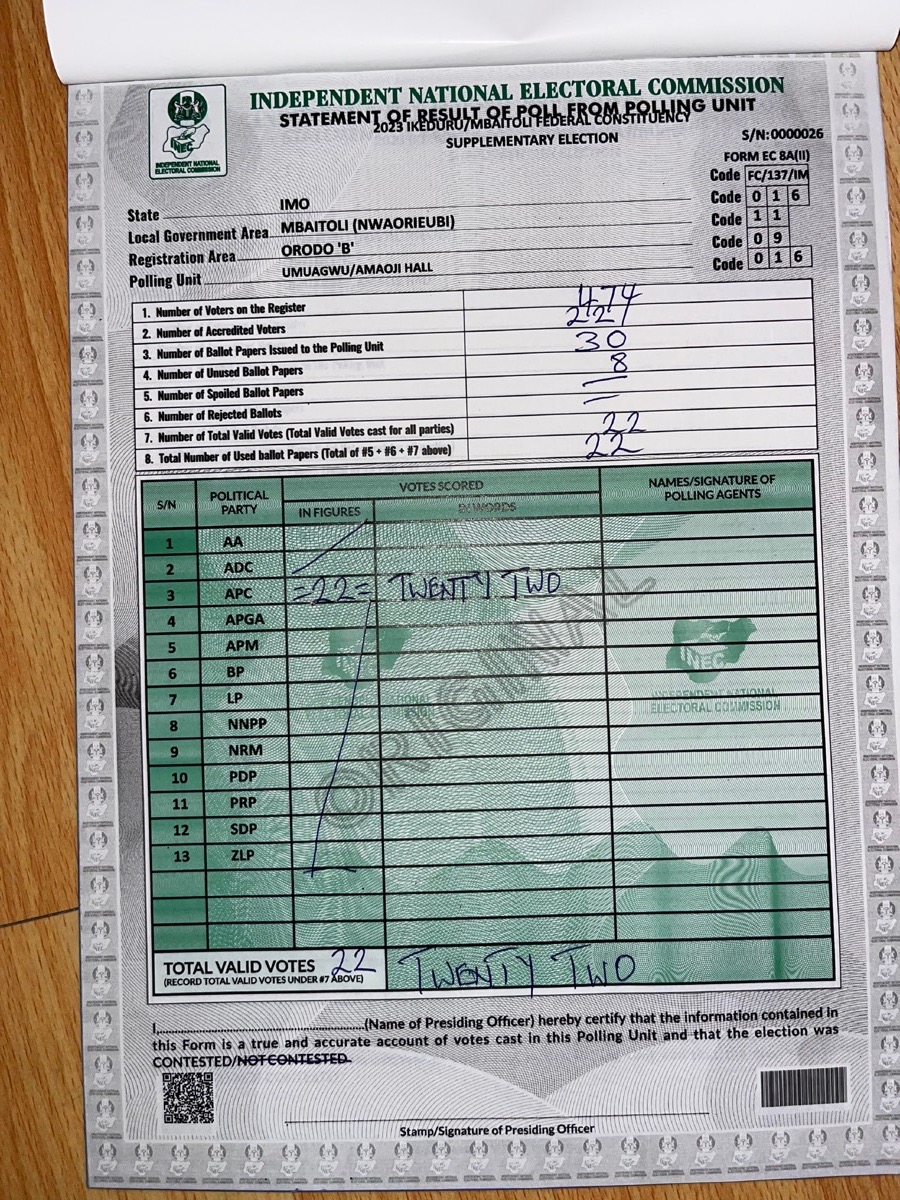
05:31:34 WAT · 22 valid votesIReV PDF →
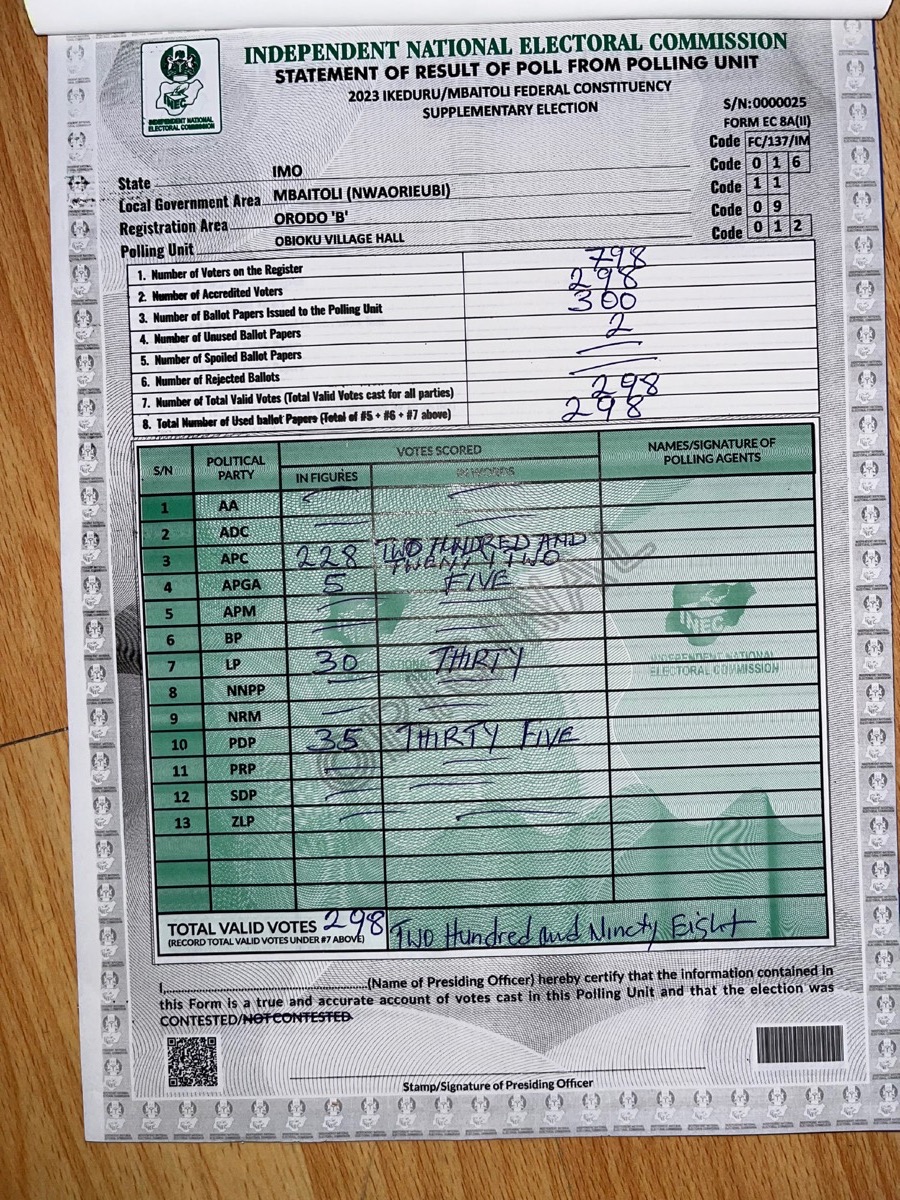
05:31:49 WAT · 298 valid votesIReV PDF →
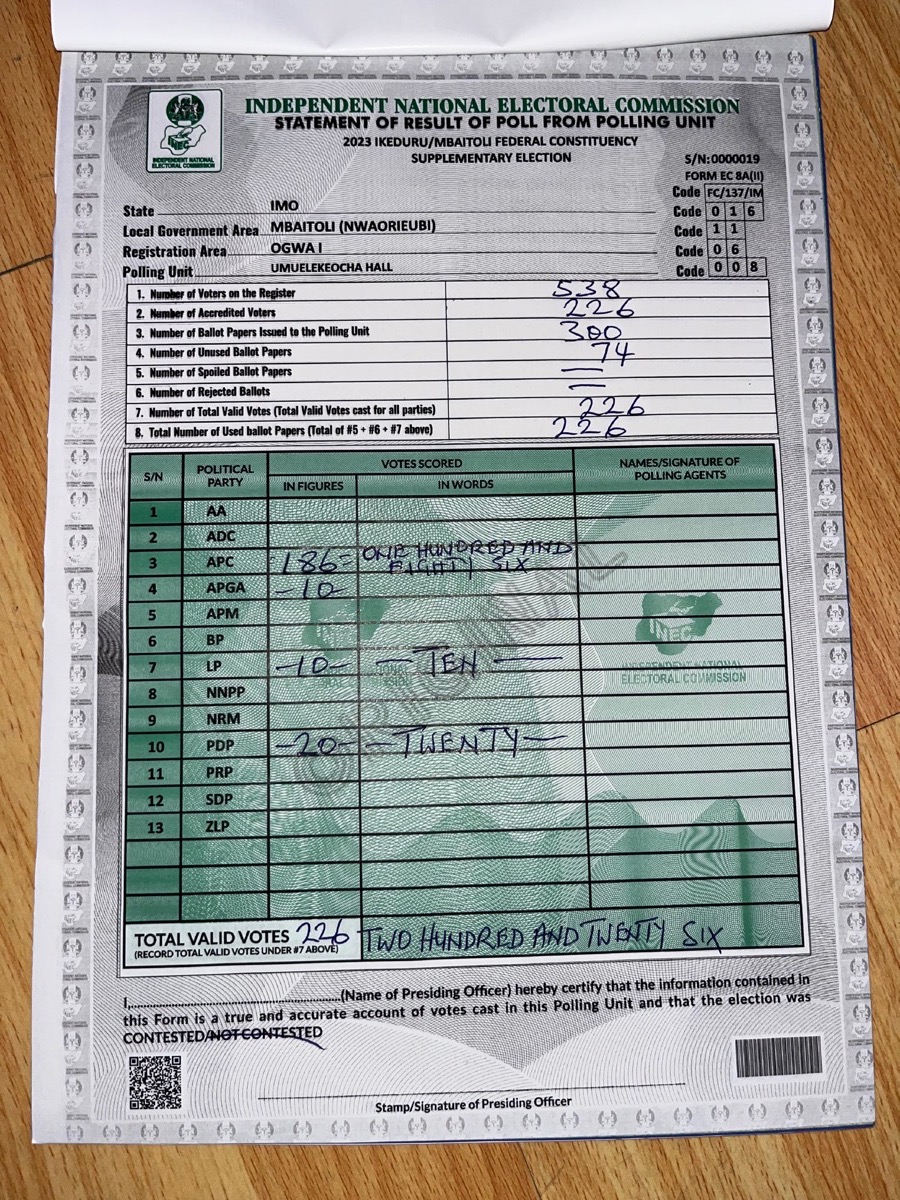
05:34:02 WAT · 226 valid votesIReV PDF →
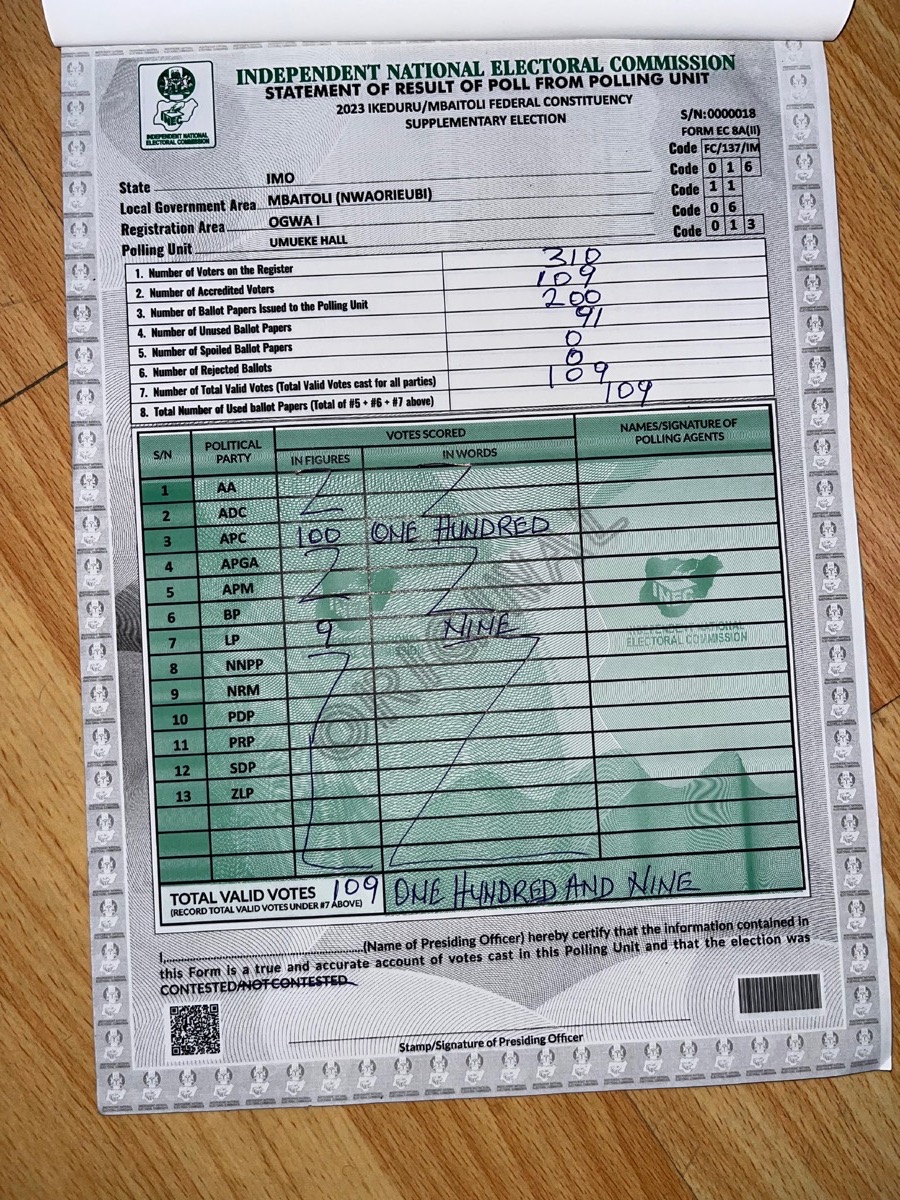
05:34:17 WAT · 109 valid votesIReV PDF →
Questions for INEC
The records now require a documented explanation
- Were these 24 photographs taken with one physical iPhone 13? If not, what identifies the devices that created them?
- Why do result sheets assigned to six wards appear to have been photographed against the same wooden background?
- Were the embedded 5:04–5:34 a.m. times accurate? If the device clock was wrong, what was its recorded offset on election day?
- Can INEC release the relevant BVAS device identifiers, original photographs, upload logs and audit trail for the 24 polling units?
- Why do the published copies show no clearly completed presiding-officer certification or polling-agent signatures?
- Can INEC publish the ward, LGA and constituency collation forms needed to trace these 24 polling-unit figures into the final declaration?
Method and limits
How Mundx checked the 58 supplementary records
INEC’s delimitation summary lists 58 polling units for the Ikeduru/Mbaitoli Federal Constituency supplementary election on 15 April 2023. The audit inspected all 58 IReV-linked result files.
The 58 records were selected by election-day document identifiers and independently confirmed by the “Supplementary Election” heading printed on each result sheet.
Every audited PDF hash matched the preserved source inventory. The 24 iPhone-linked photographs also have 24 distinct embedded-image hashes.
Mundx extracted the original embedded JPEG metadata from every PDF and normalized camera times using the explicit timezone offset when it survived.
The 24 iPhone-profile photographs were reviewed individually for background, framing, officer certification, polling-agent fields and the stated total-valid-vote figure.
The 24 stated valid-vote values were manually transcribed and added twice. Grouped subtotals of 2,549, 2,230, 1,926 and 1,376 sum to 8,081.
No usable latitude or longitude survives in any of the 58 photographs. The common-setting conclusion is a visual inference, not a GPS finding.
EXIF fields are editable and device clocks can be wrong. The metadata records what the published files contain; it does not authenticate the clock or explain the conflict.
Audit completed 30 September 2026. One record, polling unit 16/11/02/002, still points in the IReV API to the unavailable legacy document host. Mundx used the exact previously preserved PDF, whose SHA-256 hash matches the source inventory.
Public records require an audit trail
INEC should release the original device and collation records.
The photographs raise precise, answerable questions. The evidence needed to resolve them sits with the institution that conducted the election.